 Listen on Spotify
 Apple Podcasts
When we talk about the future of User Experience, the conversation often jumps straight to AI models, automation, and performance. But what if the real challenge isn't prediction — but judgment?
In this episode of Le Podcast on Emerging Leadership, I had the pleasure of discussing this question with Sebastian Cao, a UX and technology leader who has worked at Red Hat and Tesla, and who recently taught a Stanford course on the future of User Experience.
His perspective is refreshingly clear: technology only creates value when it strengthens human capability.
In this episode, we discuss
- •Prediction (machines) vs judgment (humans), and why the best systems are guided, not automated.
- •From "Service Automation" to "Service Augmentation" — why words shape adoption.
- •The "ghost in the machine": transparency, confidence levels, and trust.
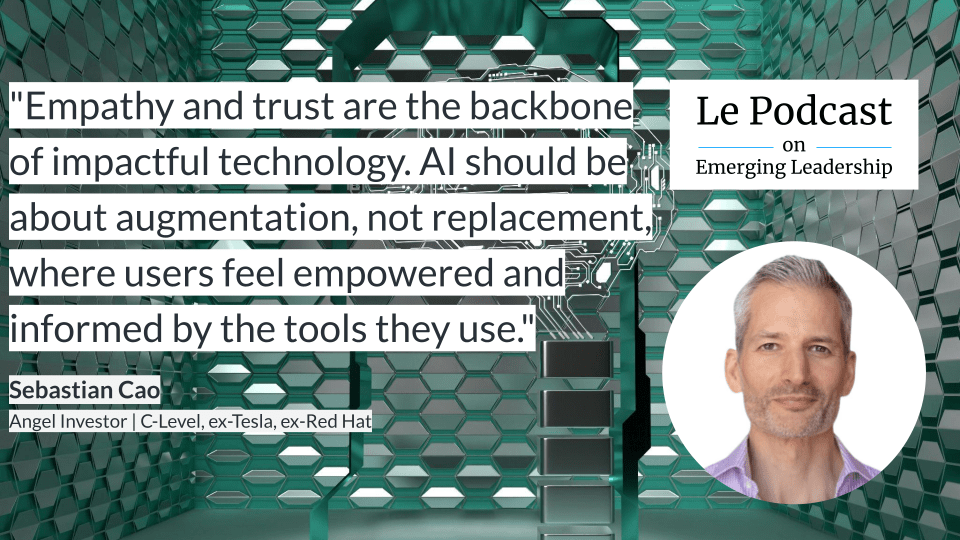
- •Empathy as an engineering requirement — go where your users actually work.
- •Open source as a practical condition for trust and accountability in AI.
- •Leadership in a human-centred AI world: technical literacy + empathy + responsibility.
References mentioned in the episode
- Tesla — Service Augmentation team experience
- Red Hat — open source as a practical condition for trust
- National Air and Space Museum — "Failure is not an option" Apollo wristband
- The Police — Ghost in the Machine (1981)
Transcript
Alexis:
Welcome to the podcast on Emerging Leadership. I'm your host, Alexis Monville. Today, we have a fascinating conversation with our guest, Sebastian Cao. Sebastian is a visionary leader with a wealth of experience at the intersection of technology and user experience, having held pivotal roles at Red Hat, Tesla, among others. He recently delivered an insightful course at Stanford on the future of user experience, where he explored critical topics like AI's role in augmenting human capabilities. So we are thrilled to dive into these topics with him today. Sebastian, welcome to the podcast. How do you typically introduce yourself to someone you just met?
Sebastian:
Thank you Alexis. I love to be here. I usually say that I'm an engineer that can talk about problems that could be solved with technology. I like to talk about problems that are worth being solved — like real problems, talking about as a species, worldwide, globally — problems that we have, and what are good options and good ideas to solve with technology. So that's how I introduce myself.
Alexis:
I love those kinds of introductions where I need to ask more questions to know a little bit more about your background. We'll go through that. You did a Stanford course about the future of user experiences, and you emphasized the balance between prediction and judgment. Can you tell us more about that?
Sebastian:
Yeah. As I mentioned, I'm an engineer, computer-science engineer, but I'm certainly not the kind of guy that would go and hack and make an LLM model better, or just squeeze a little bit more incremental performance out of a model. I'm more concerned and interested in how that model could really solve human problems.
I moved to Silicon Valley a few years ago, and you read all the stories and the heritage around this area. You see all these companies, but it's still a really engineering-led culture. Right now everyone is competing — it's an arms race about who has the biggest, boldest, more expensive model.
From my two years at Tesla I was concerned about how we can solve real human everyday problems for frontline workers. When I was discussing this with the engineers coding the big models inside Tesla, we agreed: computers will always be better than us at prediction — taking a huge amount of historical data and seeing patterns. With high probability, X will happen because the data shows it happened before. So in a car company, you take all the historical repairs and you know that certain types of cars, in certain weather, when driven in certain patterns, usually break this part of this subsystem after X miles. Great — we should be doing that. We were predicting diagnostics with machine learning.
What I wanted to add to the equation — because it's the part that's easy to forget — is judgment. Human judgment. The mechanic or technician sees the car coming in and, by touching it, by feeling, by looking at it, sees that something else is off. Maybe there was a hard brake, or a crash. We humans are good at this — we remember seeing it before, we made a decision back in the day, and the outcome is part of our experience.
So how do we merge both? How do we merge the cold data coming from the car with the opportunity for the technician to make a judgment call? I was pushing not for an automated result but for a guided diagnosis process — where the machine provides the probabilities from the sensors, and the technician uses that to make their own judgment. That's the concept I'm in love with right now. Don't think about it as artificial intelligence, but more as augmented or amplified intelligence — where we make humans better because we feed them with pre-analyzed data and a lot of prediction, but we leave room for judgment.
Alexis:
Okay, so a large place for human, but not only human — the experience they have in a particular field. And that could be any field.
Sebastian:
In this case we're talking about mechanics — technicians who take wrenches with their hands. They're not coding, they're not engineers, they don't care about machine learning. How can you give them more — especially when they're compensated based on the number of cars they go through? Tell them a story: with these augmented tools they can go through more cars per day, per week. They're more productive, they get a better paycheck — everyone is happy.
But as an industry, coming from any software company, we tend to fail at telling that story. We go: this is the latest, this is the latest LLM. We don't understand who the customer is, who's on the other side consuming the technology, how they're incentivized, and what they're trying to solve.
Alexis:
AI is not a replacement for human intelligence — and human intelligence, their experience and how they understand the world, is something important. So they can be augmented. How do you do that practically?
Sebastian:
That's where I learned a lot and made a lot of mistakes. I'm still looking for the company that will actually crack that code. Right now everyone is fighting about releasing the biggest model, spending billions in training. There might be companies doing this well, but we haven't seen them in the headlines. It's all about the biggest model and the competition between providers. No one is saying: this model — biggest or not — is actually increasing productivity for frontline workers, technicians, insurance clerks, customer support operators, airlines, whatever. We're still failing at deploying those models alongside human beings working side by side — the whole copilot idea.
Where I see us failing first: as engineers, when something is too complicated, we throw a lot of technology and explanation at it, and we tend to use the words automation and artificial intelligence a lot. If on the other side you have someone who doesn't come from our industry, the first thing that comes to mind is: this is automation, this is going to replace me. No matter your intention.
One of the first things I did at Tesla — the team I inherited was called Service Automation. We were tasked to create more tools for internal customers, for employees. I said: the first thing I want to change is the name. Every time I introduce myself as Service Automation, they say: okay, you're coming for my job. So we changed it to Service Augmentation. I started sharing research and analysis with both sides — the engineers building the software and the technicians on the other side — saying: this is what we're trying to build, something to help you go through your day, to augment you. Augmentation is still a 20-dollar word; maybe amplification works better. But just changing the name matters, because words carry a lot of weight. Right now in the media it's much more interesting to publish a story about automation or AI taking jobs than about AI making people better.
Alexis:
It's very interesting how we oscillate between a one-world and a five-thousand-world, mixing them in one sentence and scaring everybody.
Sebastian:
It's human behavior. We jump from "this is going to be a great feature" to Skynet and Terminator and the Matrix. And that sells. So for people like us, you need to understand the technology, but also explain it — explain what's going on, explain why you're using it.
Alexis:
And that's a very good point. You need to care about the users themselves — the people who will really use the technology — and go further in understanding how they work and what they're trying to achieve. It's not a game about features. You picked an example about the ghost in the machine, and I was very curious about that. I'm probably old enough to know about that album from The Police.
Sebastian:
1981, great songs. I have a t-shirt with that album cover, and I used that t-shirt when I went to a meeting where I wanted to explain the concept. The ghost in the machine is the idea — a phrase that's been around forever, related to the Turing test — that if a machine is new enough or strange enough, you feel there's something else, a soul, a human touch. Most people got that experience with ChatGPT two years ago. If you delve into transformers, you understand it's a pretty big program choosing the next word. But at first it feels magical.
If we don't explain what's going on — if it's a black box — you don't explain where the data comes from, who selected it, who labeled it, how it was used to make a decision, or in simple terms the confidence interval ("we're pretty sure, up to 80%"). I was pushing for graphical representations: this is a recommendation based on this data. We need to get better at this. With these models you ask a question, you get a response, but there's nothing that explains how that response was constructed.
I was dealing with frontline workers, sharing with them: we're giving you this recommendation because A, B, C, and D happened before. You're relying on millions of rows of data from previous repairs — historical repairs done by other technicians over ten years. Just by sharing that with the technicians — "this is recommending what to do, but it's trained on what your peers have done in the past, it's the shared knowledge of your peers" — they embrace it much more. If it's just a black box saying "do this," they'll do the opposite.
Alexis:
What I really like there is not just trying to explain how the feature works, but showing the work that's done — explaining all the reasoning that got us to the conclusion. The model is just trying to predict the right next word based on historical data. Once I understand that, plus a confidence level, I can trust it — or I can say: ah, the confidence is very low, there's not much historical data on my situation, I should pay attention. That's very interesting.
Sebastian:
Spot on. And you mentioned a key word, Alexis: trust. The other word I kept using in all my meetings with product managers and engineers was empathy. You need to increase empathy so people say: this is helping me, I'm rooting for the software, because as it becomes better, I become better. We're peers, partners. If I think you're trying to replace me, I'll do my best to hijack and kill your project.
Alexis:
You have a fascinating career trajectory — founding companies in Latin America, working at Red Hat in Latin America and the US, working in Silicon Valley for Tesla. How do you see the role of technology in customer experience now and in the future?
Sebastian:
One thing I keep repeating, and I keep telling friends in Latin America who go "oh, Tesla, Silicon Valley — that's great" — and you can relate, being in France: at the end of the day, here you'll see bigger ammunition, bigger weapons, bigger things being built for global scale, but we're solving the same kinds of problems. Cultural change, resistance to change, human behavior — the same in Silicon Valley, in Paris, in Buenos Aires, in Brazil, in Africa. If you throw a fully automated machine-learning diagnostic at a technician without explanation — in Tesla, in France, in Turkey, in Latin America — they'll resist it.
That realization was important. I'm in Silicon Valley because you're exposed to a global scale of problems, you have bigger resources and tools — but the problem you're solving is still a human problem, the same no matter the language or the color of skin. Even with everything happening in AI, at the core we humans are still the same. We fear the same things, we need the same kind of help. So I like being here and seeing everything happening with AI, and at the same time I'm super interested in how we'll build all of this with good adoption and empathy.
Alexis:
That's the right balance — technology and human touch. Empathy you build with users to foster adoption of technology, and the idea of innovation itself.
Sebastian:
I read as many psychology books as coding or AI books. I think we need both — especially with AI right now. You're going to be exposed to technical discussions, code, diagrams. But we also need more people who can understand: okay, we built this, we shipped this product, this is what's going to happen. And if you don't know — at least catch a bus or a taxi, go where your users are, sit with them, see them in action. In my case it was going where they were actually wrenching cars and working with them. You have to work with them, understand what they're doing. If you ship code into production without ever talking to, touching, and feeling your customers, it's going to be hard.
Alexis:
I had a conversation with a really high-performing team. Looking at what they were doing every week, I noticed all team members had real-user interviews every week. Not all of them every week, but every week there was contact with at least one user — different people on the team. They had a user interview guide that constantly evolved because they were testing assumptions with different users. So a successful team probably needs to be in touch with their users at least weekly, and that shows up in their work.
Sebastian:
Agreed. Successful B2C consumer companies' product management teams know that and have been doing it. With AI we're trying to augment decisions — so it's even more important to be there and understand how a person makes decisions if you're trying to build something they'll use day to day. Otherwise you end up with Clippy from Office in the 90s.
Alexis:
Yeah — the first question everybody asked was how to turn that thing off. Finally, as a leader who has worked in different high-tech environments, what advice would you give to a new leader who wants to evolve effectively in that world?
Sebastian:
Today you need exposure to the technical side — understand what's going on, how it's being created, why, and by whom. There are political things at stake, companies competing against each other; you need to understand them. We probably need another podcast on open source vs. closed source for AI. Those are tools in your tool belt.
What I'd like leaders to do — and we've been discussing this — is to be empathetic, understand who's on the other side. Who's your customer? B2C, B2B? Are your users experienced with AI or not? Do they trust it or not? If you ask those questions and get answers, work with them. Too often I see us shipping code without asking any questions, thinking the code is the best and adoption will follow. We need a little more human touch. So my recommendation: human touch and empathy.
Alexis:
Excellent. People won't see that on video, but I can see it on your wrist — you have an interesting message. Tell me more about that.
Sebastian:
Yeah, it was lying around. This is a wristband I got from one of my favorite places in the US — the Air and Space Museum in Washington, DC, where you have all the historical planes and the Apollo missions. The wristband says "failure is not an option" — it was created for the Apollo team before sending someone to the Moon. You see how much was achieved in collaboration between private and public sector, different political views, all in about six years. It's amazing.
Alexis:
I like the story and the message. And at the same time, you mentioned open source a second ago — don't we say "fail often, fail fast"?
Sebastian:
Oh, you got me there. Okay, we have another hour and a half… I don't like the idea, with AI and everything that's going on, of "fail often, fail fast" — just releasing whatever it is. This is something talking at you, and many people are making decisions based on the answers it gives. If it's not curated, if it's biased, a lot of things can go wrong, and we've seen examples. So the ethos of "move fast and break things" — I've never liked it that much, especially with AI right now.
The other part: I think open source needs to be much more involved. Back to the ghost in the machine and the black box — if that model is answering my questions, I want to understand who built it and who made the initial training and answers. I love what a lot of companies in France are doing — taking a more human approach, mostly based on open source. Personal opinion: if it's all handled by one big corporation with all the data, closed, we've seen that before, and it's never a good story. Maybe you have your closed source — that's good — and an open source equivalent that's good enough. It's your choice, but at least you have an open-source choice. I wouldn't trust my frontline workers to make decisions affecting customers based on a model I don't know exactly how it was built.
Alexis:
Totally agree — and we're back to trust, with transparency as the foundation to build it. I'm happy I asked the question about failure. Thank you for joining the podcast, Sebastian. You have been great.
Sebastian:
Pleasure, Alexis. Let's do this again in the future. Take care.
 Castbox
 Amazon Music