 Listen on Spotify
 Apple Podcasts
Remote work is often treated as a question of tools: video calls, chat, shared documents, and the right stack. Lisette Sutherland disagrees.
For her, the real topic is remote collaboration — and the hard part is not technology. It's the human side: how we handle conflict, how we build trust, how we manage overload, and how we stay connected without relying on proximity.
Lisette is the founder of Collaboration Superpowers, host of the Collaboration Superpowers podcast, and author of Work Together Anywhere (now available in French). Her work draws on an international life across Germany, the United States, and the Netherlands — and on years helping teams learn to work together from anywhere.
In this episode, we discuss
- •Why remote isn't really about tools — it's about navigating personalities, conflict, and connection.
- •Two classic failure modes: a teammate working at a different rhythm, and personalities that just don't gel.
- •Why flat teams without a clear decision owner need explicit conflict protocols and outside facilitation.
- •You don't have to be friends to work well together — professional trust is enough.
- •Start with a personal user manual, then build a team agreement — and tackle communication overload head-on.
- •WordPress's P2 model: documenting decisions to build an organizational memory and eliminate email.
- •Hybrid PI planning across Malaysia, Canada, and Europe — and why dress rehearsals are the secret weapon.
- •Face-to-face is a catalyst, not a requirement: how an Airbnb in Lisbon changed an entire team's dynamic.
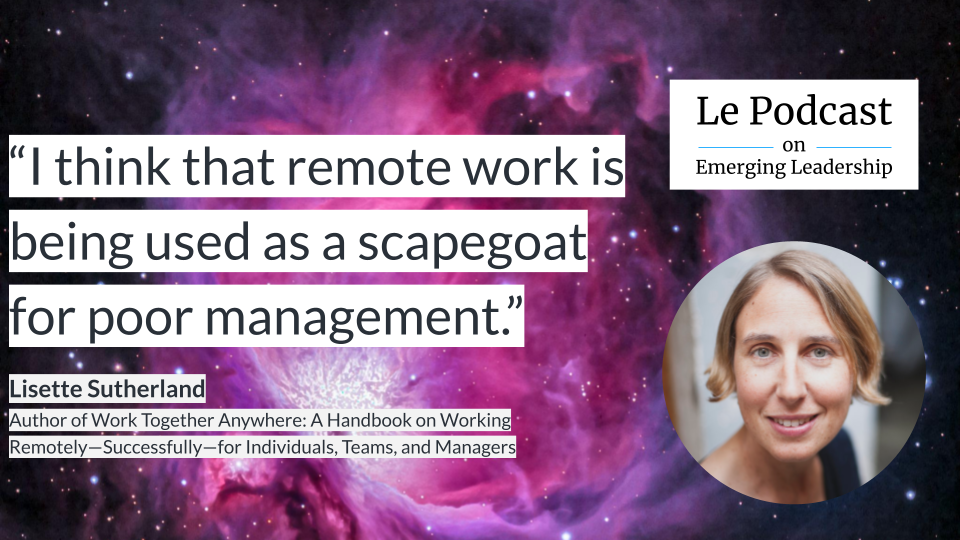
- •Remote work as a scapegoat for poor management — what the return-to-office backlash really reveals.
- •Icebreakers Playground and virtual Pomodoro co-working — two experiments worth trying.
References mentioned in the episode
- Collaboration Superpowers
- Remote Working Success Kit (Super Kit)
- Work Together Anywhere: A Handbook on Working Remotely — Successfully — for Individuals, Teams, and Managers — Lisette Sutherland
- Moving Motivators — Management 3.0
- WordPress P2
Transcript
Alexis:
Welcome to Le Podcast on Emerging Leadership, I am Alexis Monville. Today we have a special treat for all of you who are navigating the complexities of remote work and leadership. We are joined by Lisette Sutherland, a pioneer in the realm of remote collaboration. She's the force behind Collaboration Superpowers, a platform that equips people and companies to work together from anywhere. Lisette is also the author of the book Work Together Anywhere, a comprehensive guide to thriving in a remote environment. And the book is now available in French, by the way. With her hands-on workshops and her own podcast, she's been helping teams across the globe to connect and collaborate effectively no matter where they are. Hey Lisette, how do you introduce yourself to someone you just met?
Lisette:
I try to keep it as simple as possible because nobody wants to hear a long story, so I always just say I help teams work better together remotely. I kind of leave it open and that way if people want to ask a little more, they can ask it from whatever angle they want to. And otherwise, if they look at me with deer eyes, I just kind of move on to the next subject and ask about them.
Alexis:
I love it. Can you share a specific moment or experience that led you to specialize in remote work?
Lisette:
Yeah. It was a long series of small events, but really where it actually started was when I was living in Los Angeles almost 20 years ago, and I was working for a man who was building at that time an online project management tool. Now you have to remember, this is 20 years ago, and those tools were not available. Basecamp had just started, Zoho was still a very popular tool on the market. There weren't that many tools out there.
He had us all over to his living room one day and he sat us all down. He had a swimming pool — Los Angeles, so many people have pools — so it was like a pool party. But he sat us all down and he started to explain his vision. His vision was he wanted to end aging. He didn't want to die, so he was trying to figure out how to get longevity scientists collaborating together so that they could solve the problem of aging. He realized these scientists didn't live in the same town. He needed to create a tool for them to collaborate and share data and solve this problem. I remember sitting in his living room and my mind was blown. I thought, well, why not?
But the thing that happened was it got me thinking about what else could we do if location wasn't an issue. Could we solve cancer? Global warming? I had also quit a job earlier — I worked for a big office, and I didn't quite understand why I needed to quit. I just knew in my body that I needed to. Eventually I learned later that it was because the office was so ugly. I was having an allergic reaction to the gray walls and cubicles. So all of this played into me getting interested in remote work. I started asking people how they were working remotely. Everything else followed in a long series of events, but it really all started with that weird conversation in that man's living room.
Alexis:
That's very interesting — that's more than remote work, that's really that idea of remote collaboration.
Lisette:
Exactly. I don't care about remote work at all. For me, it's way more exciting, because what ended up happening after that conversation was my favorite band from when I was a teenager called me to see if I could go on tour with them. Because I was working for this man who was building an online project management tool, I was able to work from the van with my team during the day with a mobile router stuck onto the window of the van, and at night I was tour manager and selling merchandise and part of the band. I was on tour with them for years doing this. The freedom that being able to work from anywhere offered me, changed my life.
Alexis:
That's excellent. Are you originally from Los Angeles?
Lisette:
No, I have a weird history. I grew up in Germany for the first 10 years of my life, then went to the US for 25 years. So I consider myself American — my roots somehow as American. But 15 years ago I moved to the Netherlands. I've been in the Netherlands ever since. Now I have Dutch citizenship, so I'm never going back. I'm kind of a mix.
Alexis:
That's well connected with working from anywhere and living from where you feel your home is.
Lisette:
And it opened me culturally also to understand how different cultures are. To have an awareness of that helped.
Alexis:
I can totally relate. When you are used to working with people only from the same country, you understand really well the interactions, the way they communicate. And suddenly when there's someone from another country who doesn't have exactly the same norms in terms of communication... When you get to work with people in a lot of different countries, that changes your perception of others.
Lisette:
Yeah, indeed. And you never think it's going to be that big of a deal. I moved from the US to the Netherlands, so it didn't seem like it was going to be that huge of a culture change. But it's the little things, it's all the details. Never underestimate all the details.
Alexis:
Can you recall a challenging remote work situation and how you navigated it?
Lisette:
In the early days, all the remote situations were challenging in that it was unusual. The internet connection wasn't good everywhere — it was quite painful to try to really interact with the teams. For me, the most challenging remote work situations now, now that the tech is better, comes in the personalities of the people that I'm working with on teams. The conflict, trying to understand somebody else — that is where it's super challenging now, even for me. Just really trying to navigate personalities and figuring out why people are the way that they are. I tend to be very judgmental and defensive — which are not good qualities — and so it's extra hard work when something happens to not have that knee-jerk reaction. I really have to force myself into curiosity mode. I wrestle with it weekly.
Alexis:
I like that you're self-aware enough to catch yourself.
Lisette:
Sometimes. I'm no angel, I'll admit. But I am working on it.
Alexis:
Do you have a real-life example where poor communication led to a problem in a remote setting?
Lisette:
Yeah, for sure. I'm thinking back to when I was on the Management 3.0 team. The team changed quite a lot, people coming in and out. But there's one person where they worked at a different rhythm than the rest of the team. They were just so much faster — moving at freight train speed and the rhythm really threw everybody off. We were having a hard time communicating about it because you don't want to tell somebody to slow down. He was kind of taking over pieces of everybody's jobs because he was just getting them all done, and everybody felt like they were getting stepped on. So that was a difficult conversation. We all wanted to applaud his enthusiasm, and yet were really annoyed by how many things he was trying to take care of.
And then there was another situation where the personalities just didn't gel. In that case, it prompted us to create a new section in our team agreement about how we were going to handle conflict as a team. What ended up happening was everybody was talking behind everybody's back, and it's online — so you're in all these private chats all day, whispering back and forth. Eventually we brought in an outside facilitator to help facilitate the conversation, because everybody was too close to it. The other thing that was odd in that situation was we had a very flat structure. There was no boss, no one in charge. So when a situation like that arose, there was no manager to make a decision. We just had disagreements and nobody to make the top decision. The outside facilitator had no skin in the game and that really helped. From there we built our processes for the future. But I have to be honest, we never ended up getting along. We just never liked each other. But I also learned that you don't have to like each other to work well together. You can still work well together and not be friends. That's also okay.
Alexis:
That's a good one about building team agreements and evolving them, and sometimes you need an outside facilitator. And I like your second point — you don't need to be friends. It's an interesting one about what your expectations are on being on the team. For some people, that's definitely befriending everybody, and it's not necessarily helping them or helping the team.
Lisette:
Yeah. You have to be professional, but it's great when you become friends. Some of my closest friends are people I work with — Canadian Dave, I have worked with him since I was 22 years old, we're still friends to this day. But I learned you have to be professional. You don't have to be friends. It's great when it happens, but it's not a requirement.
Alexis:
That's cool. Have you consulted for a company that has successfully transitioned from the traditional setting to remote work?
Lisette:
I have never consulted, really. I'm not a consultant — I made the distinction early on. What I have always done is give workshops. I go into a company and give a workshop and we create a Super Action Plan. Then usually the companies have an agile coach or a Scrum master, somebody on their team that's helping them integrate these new practices into their everyday work. Because remote work, in the end, is a change-management program. So I specialize in giving the workshops and seeding the information, and there's an agile coach or a consultant already at the company that takes over. I have given workshops for hundreds of companies that have transitioned from in-person to remote.
Alexis:
What are the typical things that need to go through, or that they need to already understand, so it can work?
Lisette:
One: I always start people off by saying you really need to start with yourself and create for yourself a personal user manual for what you need in order to be productive. Get really clear on that. If you need to be around people, build that into your day. If you're not getting enough movement, whatever your why is, really be clear.
From there, I always say you've got to build a team agreement. Everybody knows this. I've been saying it since the beginning, and yet I would say 85, 90% of all companies that come to my workshops have no team agreement in place. Creating a team agreement is the next thing.
The other biggest thing people are running into is communication overload. Too many meetings, too many emails — the bombardment of information coming in is not slowing down. We've tried filters, flags, priorities — it doesn't stop the information from coming. When you're together in the office, you can manage that information overload by proximity. But when you go hybrid — or just flexible-first — that information overload with everybody in various locations has to be managed differently than we're doing it now.
Alexis:
Have you observed an innovative work model recently that solved those kinds of issues?
Lisette:
Yeah, indeed. The gold standard for this is WordPress, because they created a system called P2 years ago and have actually eliminated email from the company pretty much 15 years ago. Every time a decision needs to get made, it goes into a sort of blog post where others can add information to it — maybe a Loom video, a link, outside information. Everything gets documented. Over time it has created an organizational blockchain of all their decisions. Instead of all these emails going back and forth, or a meeting about why is this thing blue, they have a record of their organization and all their decisions to go back to so they don't have to reinvent the wheel.
Another innovative work model: a huge company in Germany that has recently transitioned from in-person to remote. They started running hybrid PI planning sessions for around 100 people across Malaysia, Canada, and Europe — 12-hour difference. Usually you want to do PI planning all together in the same room with a big whiteboard with sticky notes. Of course you would want that. But the reality is they can't. The focus and attention they're putting on that to make it happen — I find it very modern and refreshing.
Alexis:
That's very impressive. How many people are involved in those hybrid PI plannings?
Lisette:
100. And the guy who did it really experimented with it in the beginning. He actually ran practice sessions with all of the teams before they did an actual PI planning session — to get used to how to behave on the whiteboard, how it's going to be used, how to communicate with each other as it's happening. They ran the session and it's working. It's still painful, but the reality is they can't get everybody together.
Alexis:
That's confronting the brutal reality. Those big-room plannings, when they are in person and well facilitated, are usually really good. But when you cannot do it, you need to find another big room — and an online one can work. I love the idea of the practice session. So many times you start something and assume everybody will be able to use the tools. Then you realize they're not able to connect, or they don't understand how to even create a sticky note, and you spend the first half hour trying to explain to people while others are really frustrated by those people. That's not really a good start.
Lisette:
Totally. A dress rehearsal — it was brilliant. He really spent a lot of time on this. However, now they can do PI planning sessions on a regular basis. Anybody new will be helped by the collective of people already working on this. He spent a considerable amount of time upfront, but now they're up and running and only going to get better. The superpower this company has now developed was well worth any investment.
Alexis:
Could you share an anecdote about a remote team-building exercise that had a significant impact?
Lisette:
This was a hybrid experience. I was working with people in person and remote. I was the only woman on an all-male team. It didn't even occur to me — it wasn't a thing — but it was so obvious. And I was the only American on a team of all Dutch men. I have a naturally enthusiastic personality, and I was really trying to tone it down and keep a professional distance with everybody — not letting my enthusiasm or natural humor come out. My humor doesn't come across as well in other languages — I can really express myself better in English.
I played Moving Motivators with one of the people at the office. He saw it on my desk, knew I was working with Jurgen. We actually played a game of Moving Motivators together. And what happened from the game is, it turned out that his primary motivator was relatedness — he needed to be friends with the people he worked with. That was really important to him, much more than anything he was working on. And he had been trying to be friends with me, and I was shutting him down. When I saw that his big thing was relatedness, it was an aha moment. It allowed me to let the guard down a bit. We became friends and we're still friends to this day. I owe it to that game because I didn't realize he was trying to reach out.
One of the things I think the context we sometimes miss when we're remote is what people need in order to feel connected on a team. You really have to ask people what they need in order to feel connected. He needed friendship, and I was just trying to fit in.
Alexis:
I'll put links for the listeners. Jurgen is Jurgen Appelo. Moving Motivators is one of the Management 3.0 tools. You're absolutely right that connectedness — sometimes we are able to build it in person more easily, but not always, because you still need to be intentional about it. Online, you definitely need to be intentional. Using those kinds of games to understand the motivations of others — that's fantastic. You are also the host of a podcast I love — Collaboration Superpowers. Can you tell me about a story from one of your podcasts that had a significant impact on your understanding of remote collaboration?
Lisette:
There've been so many. I do the podcast in order to learn myself. I look back and see how people use their podcast as a sales tool, and I'm a little ashamed because I've never even thought about it. The podcast was always a way of networking with people that I wanted to talk to.
There was Teo Härén, a creativity expert from Sweden, who wrote a book about why it's important to change your place when you work. He said, if the best place for you to work is the office, then you need to work at the office. He has yet to meet one person who says 100% of the time, all year round, the office is the best place to work. He really solidified for me that it was important for people to change their place just for the sake of creativity and innovation. Sitting in that same gray cubicle every day was not innovative.
When I spoke with Phil Montero — one of the leaders in this field way back in the day, way ahead of his time — he came up with the team agreement. I took it with his permission and ran with it.
This was reinforced recently when I spoke with astronaut Paul Richards. I wanted to interview him about extreme remote collaboration — they're working from space. What he said is that astronauts train to have the right information at the right place at the right time. In Houston at headquarters, all the channels are open. Everybody's listening in on all the channels. It's like having Microsoft Teams and Slack and everything open at the same time. Madness. But they all have specific protocols about getting attention in a particular place, or showing somebody something in particular. There's a protocol you use, and all of a sudden that person is dialed in.
It occurred to me that this is similar to what we need on remote teams or hybrid teams: intentional working is the superpower. There's no one right method, no one right tool. It's all about being intentional about how you work together. If the astronauts left it to chance, it would be madness. It's the same for remote — you can't leave it to chance.
Alexis:
Once again, the intention is really key. So how important is face-to-face interaction in this age of hybrid remote work?
Lisette:
I think it's really important, but I don't say it's critical. It's not necessary — you can do team building online. We've seen evidence of it in many different places. But face-to-face sure does make things faster and it enhances it. It acts like a catalyst — speeds things up.
My experience with the Management 3.0 team was: we worked together for four or five years before we ever got together in person, because I was insistent that if anybody could build a remote team, I could do it. What kind of confidence was that. Then we got together in person and it changed the whole thing. We got an Airbnb in Lisbon, and the team went out one night — alcohol was involved, we were very drunk and dancing in the streets of Lisbon and having the best time. It changed the dynamic of the team. We were a very close, tight-knit team after that. From then on we met every six months and it only enhanced the bonds.
That said, I worked with a woman for nine years — she was in California, I was in the Netherlands. We virtually co-worked together for nine years and she was one of my closest friends. We finally met in person right before the pandemic for the first time. It was fun because I knew her whole apartment. I'd had breakfast with her in the morning, I'd been there when she put on her makeup. I'd seen her clothes and helped her pick out outfits. It's possible — it just takes a long time.
Alexis:
It's very interesting to see the difference. The Airbnb aspect of it — I was on that team too, we had an Airbnb. Cooking the meal together makes you close. That's probably an experience people need to live from time to time.
Lisette:
Yeah. There's just nothing like sharing a big pile of nachos together. There's nothing like that online yet — and I don't believe in replacing that either.
Alexis:
So everything rosy — but do you have a real-life experience when remote work, remote collaboration, fails?
Lisette:
We see it everywhere. It's failing now — there's all the return-to-office mandates happening. We're actually seeing remote failing on a mass scale at the moment because leaders are saying productivity is down, people are disappearing, and culture is suffering. People feel less connected to the company now. I can't dispute that. The data shows productivity is a bit down. You're hearing stories of shenanigans — people with two to three jobs, people with a robot moving the mouse so it looks like they're active. Remote work isn't for everybody, and if you want to do it, you really have to set yourself up to do it well. But people are less connected to companies — and that's somewhat the company's responsibility too. We need to figure out what people need in order to feel connected to the company.
Alexis:
I have the feeling that we are blaming remote work for that lack of connection and lack of engagement. At the same time, when I look at the Gallup survey they've been doing for more than 20 years now, engagement was already low for a lot of companies for a really long time. So yes, we can blame remote work — I'm not completely sure the reason is there, and the mandate to be back to the office will really help with that. I would encourage people to dig a little bit deeper.
Lisette:
I totally agree. I shouldn't say this on a podcast, but okay — I think that remote work is being used as a scapegoat for poor management. They're blaming remote work, but actually it's the way that we're working that's not working. It has nothing to do with remote. It's just highlighted by remote. You can't hide it with remote, weirdly enough.
Alexis:
Can you tell us about an upcoming workshop or event you are particularly excited about?
Lisette:
I'm experimenting with two new kinds of events. Our standard workshops on remote working, hybrid, leadership, and Work Together Anywhere are well-oiled machines at this point.
I'm experimenting now with something called an Icebreakers Playground. The point is to play around with various icebreakers and tools to understand their effect on group dynamics. If you're trying to get a group together to have big ideas, to think outside the box — are there exercises you can do remotely to warm a group up that way? I've called it the Icebreakers Playground because it's experimental. In my designed workshops I know exactly what's going to happen. In the playground it's really experimental. I'm uncomfortable with the improv of it all because it never goes as planned. It's always a bit scary as a facilitator, but it's really fun.
The second event is virtual co-working sessions. We use the Pomodoro technique. People show up, say what they're going to get done over the next two hours, do a quick icebreaker, then 30 minutes of focused work — camera on, sound off. Five-minute break, another 30 minutes, five-minute break, third 30-minute session. We end by checking in — what did you get done, how's it going — and a little celebration. It's amazing how much you get done with three 30-minute focus sessions. And it's amazing how much more focused you are when other people are there. They're free — we're just playing around with them to get stuff done and see what it's like to virtually co-work.
Alexis:
That's fantastic. I know there are some tasks I really want to do, and as soon as I start to work on them, I'm already procrastinating, finding new things to do, and an hour passes. I believe I'll join one of the co-working sessions.
Lisette:
Good. That's exactly what these sessions are for. If you're at home alone, you know you need to do it but don't really have to do it — if you don't get it done, it's not going to hurt anything. It's exactly for tasks like that. Join us and have some accountability. It's super fun.
Alexis:
Where can our listeners follow you to get more real-world tips on remote work or remote collaboration?
Lisette:
I've put together what I call a Super Kit — a Remote Working Success Kit. It has a guide for creating your personal user manual, how to set up a team agreement, some time-zone tips, and the Super Cards as a printable PDF. You can get that at collaborationsuperpowers.com/superkit.
Alexis:
Excellent. Thank you very much, Lisette, for having joined the podcast.
Lisette:
It was my honor. Thank you!
 Castbox
 Amazon Music