 Listen on Spotify
 Apple Podcasts
In this episode, I had the pleasure to talk with Radhika Dutt, author of Radical Product Thinking: The New Mindset for Innovating Smarter.
Radhika has lived the full spectrum: engineering, startups, big organizations, and years of learning the hard way. What makes her work so compelling is how clearly she names the patterns many teams fall into — and how practical her framework is for escaping them.
Beyond "fail fast", Radhika offers a different path: build with clarity. Define the change you want. Make hypotheses. Plan actions. Measure whether it works. Learn in a way that preserves momentum.
In this episode, we discuss
- •Hero Syndrome and the trap of grand-but-vague visions like "revolutionize wireless."
- •Why "fail fast, learn fast" comes from the VC model — and why survivor bias isn't a method.
- •The Radical Product Thinking framework: vision, strategy, prioritization, hypothesis-driven execution, and culture.
- •A good vision is detailed: who, what, why, when, and how — not broad and grand.
- •The RDCL strategy mnemonic: Real pain point, Design, Capabilities, Logistics — and why logistics can't be bolted on later.
- •Validated = verified + valued: how to know a pain point is actually real.
- •Prioritization as leadership at scale: vision fit vs. survival fit, and naming "vision debt" out loud.
- •Why a survival statement makes trade-off conversations objective instead of political.
- •The misuse of OKRs: measure to learn, not to prove.
- •Culture on two axes — fulfilling vs. urgent — and treating your organization as a product that serves employees.
References mentioned in the episode
- Radical Product Thinking: The New Mindset for Innovating Smarter — Radhika Dutt
- radicalproduct.com
- Radhika Dutt on LinkedIn
Transcript
Alexis:
Welcome to the podcast on emerging leadership. I'm Alexis Monville. Today we are thrilled to have with us Radhika Dutt. Radhika is an innovation and product management expert. She is the author of the book Radical Product Thinking: The New Mindset for Innovating Smarter. Radhika has worked globally across diverse sectors, from startups to giants. Welcome, Radhika.
Radhika:
Thank you. Thank you for having me and I'm so excited to be here with you today.
Alexis:
Could you please introduce yourself to our audience and share a bit about your background and the work you do?
Radhika:
Sure. My background is that I started out as an engineer. I studied engineering at MIT and I became an entrepreneur soon after. My first startup was called Lobby 7, and we started this with a group of co-founders — there were five of us in total — while we were still in our dorms at MIT. My whole experience has been through entrepreneurship and then working at larger companies and making mistakes along the way.
For example, my first startup Lobby 7 was where we caught the "Hero Syndrome." Our tagline and vision statement was to "revolutionize wireless" and our tagline was "enlightened wireless." If you ask me now what does that mean, I'm really not sure. All we knew was we wanted to be big. That was all that mattered. That is Hero Syndrome. So that was the first "product disease" I caught, and along the way there were other product diseases.
I've worked in different organizations and kept seeing product diseases. Over time, I watched other people make these mistakes and had to watch them suffer through it. The burning question for me in 2017, after almost twenty years of experience, was: are we all doomed to learning from trial and error, or is there a way we can learn to build products systematically so that we can avoid these product diseases? That's how Radical Product Thinking was born.
Alexis:
I'm glad you're touching on the product diseases — that's really interesting. In Radical Product Thinking, you describe the approach, but you really start to say it's a mindset change. I believe there's an exchange between Alice and the Cheshire Cat in Alice in Wonderland that inspired this. Can you tell me more about that mindset change?
Radhika:
The mindset change we need is moving away from the belief that the best way to build products is through iteration. This Silicon Valley mentality of trying different things and putting them on the market to see what works has led us to continually pivot and iterate until we find something that works. However, this mindset disguises the fact that a team can typically only afford 2 to 3 pivots before they run out of money or momentum. Teams lose momentum as they begin to feel they don't know what they're doing. They're just trying different things, and it can become demoralizing when they don't feel they're making progress.
Teams need to feel they've learned something and have a clear next step. This iteration-led mindset needs to change. We need to become more vision-driven. We need more clarity on the problem we're solving, our set of hypotheses, our planned actions, and how we will test if it's working.
It sounds obvious, but then one might wonder how we ended up with this iteration-led mentality. The answer is that it's baked into the venture capital business model. VCs invest in multiple startups, needing only one to succeed big for a return. They want startups to fail fast so they're not continually investing in something that's not going anywhere. This "fail fast, learn fast" mentality originated from the VC model.
While this VC model has led to some unicorns, it doesn't mean it's the best way to build products. It's more survivor bias than a proven method. Entrepreneurs need to realize that world-changing products often come from a more systematic and deliberate approach.
Alexis:
So what would be the pillars of the Radical Product Thinking philosophy?
Radhika:
The first pillar is seeing your product as a mechanism for creating the change you want. Until now, we've thought about a product as a physical or digital thing and its success as the end goal. We need to start with clarity on the change we want to bring about before we build the product.
The second pillar is that your product is only successful if it creates that change.
The third pillar is the idea that you can build your product systematically. You can engineer the change you want to bring about by starting with a clear vision of the end state. This vision then translates into strategy, priorities, hypothesis-driven execution and measurement, and culture. These five elements — vision, strategy, prioritization, hypothesis-driven execution and measurement, and culture — make up the Radical Product Thinking framework.
This step-by-step framework allows you to create visionary products systematically.
Alexis:
Could you tell us more about the first element — product vision? When I hear "vision," I'm tempted to think of grand visions and ambitions that aren't really grounded in reality, but I believe that's not what you're referring to.
Radhika:
Exactly. We have to discard much of what we've learned about what constitutes a good vision. We've been taught that a good vision is broad, such as revolutionizing wireless or disrupting an industry. But in the Radical Product Thinking approach, a good vision is detailed and answers the who, what, why, when, and how questions.
Whose world are you trying to change — and it's not everyone's world. What exactly is the problem and what's the solution they're using today? Why is the status quo unacceptable? When will we know that we've arrived — what does the end state look like when this problem is solved? And finally, how are we going to bring this about with our product?
Let me give an example. Here's a vision statement for a startup I had many years ago: "Today, when amateur wine drinkers want to find wines that they're likely to enjoy, they have to pick attractive-looking wine bottles at the wine store or try wines that are on sale. This is unacceptable because it's hard to learn about wines this way and leads to many disappointments. We envision a world where finding wines you like is as easy as finding movies you like on Netflix. We're bringing about this world through a recommendations algorithm that matches wines to your taste palette and an operational setup that delivers these wines to your table."
Alexis:
That's a product vision. It's not grand, but it's very clear about the problem and the change it will create for wine enthusiasts.
Radhika:
Exactly. This vision isn't about changing the world for everyone. It can be for a very specific group of people. The clarity it brings is such that even if I hadn't told you anything about my startup, by the end of the vision statement, you knew exactly what we were doing and why.
Alexis:
Absolutely. Next up in the framework is strategy. Could you tell us more about that?
Radhika:
Most company strategies I see usually read something like: "We're going to build XYZ in terms of a feature set or products. This will require an investment of X million, and we're planning to launch it in these markets. The expected return will be such and such." This type of strategy is quite vague.
What does a good product strategy look like instead? The mnemonic is RDCL, standing for Radical, where we ground it in the real pain points. The word 'real' is emphasized to distinguish it from imaginary pain points.
First we ask, "What makes someone come to the product?" That leads to the 'D' in RDCL, which stands for Design — what is our solution to the pain that brings people to the product?
The 'C' stands for Capabilities. What's the underlying engine that powers this solution?
Finally, 'L' stands for Logistics. What is the business model? How are we going to support this product? What training is required? All these questions about how we will deliver the solution are often overlooked. We usually say, "First we'll build a product and then we'll attach a business model at the end." That's what we want to avoid.
Let me walk through how RDCL comes together with the wine example. Our startup likely had a real pain point — people who wanted to learn about and try wines didn't want to read intimidating magazines. They wanted to learn in an easy and fun way. The design comes in when I consider that I can't ask you about tannin and acidity directly.
Alexis:
Yes, those are expert questions. Maybe just 1% of people would be able to answer them with absolute certainty.
Radhika:
Exactly. So we ask much simpler questions. I can infer how much tannin you might like based on how you prefer your tea or coffee. If you like it black, you probably enjoy more tannins than if you take your coffee with milk and sugar. By assessing which fruits you prefer in a fruit salad, I can gauge how much acidity you enjoy. We can construct a quiz from all of this. That's the design.
The capabilities then involve mapping this to a set of wines — a database that correlates wine varietals to those tastes. Then there's logistics: our business model. We could charge per wine. What we came up with was a subscription model — wine courses where you progress by tasting different wines and learning along the way. Another logistics example: we didn't have an inventory of wines, so we had to collaborate with partners who prioritized customer service and could implement this model. That's a comprehensive Radical strategy.
Alexis:
I'd like to revisit real pain points. When you say real and not imagined, does that mean you've verified that your users actually consider these as genuine pain points? How do you go about doing that?
Radhika:
That's where we often stumble. We assume a pain point is real because we think it is. The formula is: validated equals verified plus valued. Verified is when you've personally observed that someone has this issue — through user interviews or going into the field to watch people in action.
But even with user interviews, we can't directly ask, "Is this a pain point for you?" People aim to please you and give the answer they think you're hoping for. A good user interview asks neutral questions from which you can ascertain the pain point.
The second component, valued, is whether someone is willing to give up something or invest something in exchange for having that problem solved. Even with a free service like Facebook, people invest their time and are willing to give up some privacy. The verified plus valued question is crucial.
Alexis:
I really like the question. Moving on to prioritization, could you talk about its importance and how it's effectively implemented?
Radhika:
Often we work on a vision, and that vision gets filed away for posterity. Prioritization is where we bring that vision into our everyday decisions. This is incredibly important for leadership.
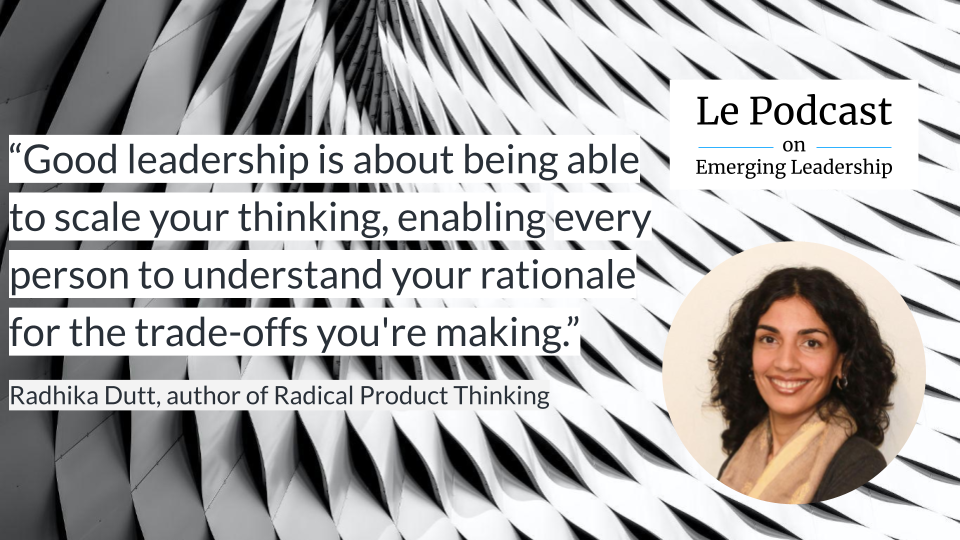
We often think that good leadership is about telling our teams what the top three priorities are. However, what I've come to realize is that good leadership is about being able to scale your thinking, enabling every person to understand your rationale for the trade-offs you're making. This way, you don't have to be in every meeting, but people know exactly what the right trade-offs are. That is what good leadership is.
The hardest thing for leaders is to communicate their intuition. In Radical Product Thinking, we recognize that when we make trade-offs, we're balancing the long-term against the short term — the yin and yang. This converts into an X and Y axis. The Y axis represents whether something is a good vision fit; the X axis represents whether it's good for survival.
Things that are good for both vision and survival are easy decisions. But if we always focus only on these, we're being shortsighted. Sometimes we need to invest in the vision — good for the vision long-term but not helping survival short-term. Examples: spending three months refactoring code, or doing user research. Customers might not see immediate benefits, but it's essential for the long run.
The opposite is taking on vision debt — good for survival but not helpful for the long-term vision. Example: a customer says, "If you build this custom feature for me, I'll sign the contract." Over time you may end up with what I call obsessive sales disorder.
None of these quadrants are bad per se, but we have to be mindful. As a leader, when you decide to take on vision debt, the most important thing is recognizing and telling your team: "Look, we need to win this deal. We're taking on vision debt." By acknowledging it, you're not making the team feel like this is a top-down loss of confidence in the vision.
Alexis:
You even discuss the idea of a survival statement. You can have a product vision statement, but also a survival statement to help the team understand what survival means at that moment in time.
Radhika:
Right. When we chart vision versus survival, one of the goals is to make decisions less contentious. Instead of "I think we should do this" versus "No, I think we should do this," plotting vision versus survival makes the discussion more objective.
We defined the vision with clarity — answering the who, what, why, when, and how. Similarly, we should define what survival means. For a startup, survival might mean financial survival. In a big company that has money in the bank, what kills the product might be stakeholder support. Writing a survival statement helps acknowledge what the short term means and make objective trade-offs.
Alexis:
Now let's discuss execution and measurement. How does it fit into the Radical Product Thinking framework? It felt a bit like you were making a case against the use, or maybe more accurately, the misuse of OKRs.
Radhika:
Before challenging OKRs directly, let's discuss what we're trying to achieve. The goal is to determine if our vision and strategy are working. Execution and measurement are about creating a set of hypotheses for each element of RDCL so that we can understand what our hypothesis is and how we'll measure success.
OKRs set goals like hitting 20,000 signups by the end of the quarter or increasing revenues by 20%. The philosophy is about setting big, lofty goals. But you have to ask if they're really helping measure if the strategy is working.
As a product manager, I have all the data behind the product. If you ask me to prove I'm meeting goals using product statistics, I have a lot of flexibility in showing that I am. But what you really want to know is how the product is doing. Is the strategy working? Do we need to change it? This requires a more collaborative approach. OKRs feel like an end-of-year exam — you either pass or fail, and the incentive is to show that you have passed. That misaligns leadership's incentives with employees'.
Instead, we want a collaborative environment where employees are encouraged to share what's working, what's not, and what hypotheses we're observing. We need a collaborative approach to create hypotheses derived from our strategy and metrics for measuring whether it's working.
Alexis:
I'd say there's a misuse of OKRs. What you described could exactly be OKRs if implemented properly at a team or product level — certainly not for individuals and not linked to compensation, as that would skew the system entirely.
Radhika:
I agree. Traditionally, people wanted OKRs because vision statements were too vague — like "revolutionizing wireless." OKRs were intended to provide a clearer narrative of the impact. But expressing it solely in numbers can lead to sandbagging — ambitious people setting goals lower for fear of failure. We definitely should not create OKRs for personal goals or for product teams, because that leads to manipulations of statistics. Even at a company level, if not implemented properly, there's a temptation to sandbag and avoid personal responsibility.
Alexis:
That transitions us nicely to culture, the last part of the framework. Can you tell us more about what you mean by culture and why it's important?
Radhika:
For innovation to thrive, we need a culture where people have a shared sense of purpose, autonomy, and psychological safety. The first two are covered by other elements of Radical Product Thinking — shared purpose comes from the vision, autonomy comes from helping people understand how to make trade-offs. The last piece, psychological safety, is about creating a team culture where people feel they're doing meaningful work, not distracted by company politics.
It's important to consider how employees perceive culture, because it might differ from your intentions. Think about culture on two dimensions: is work fulfilling or not, and is work urgent or not? When work is fulfilling and not urgent, that's the most wonderful time at work.
Alexis:
That's what I call impact and satisfaction — that's always what I'm trying to drive. Getting to that quadrant of having an impact and being really satisfied by the work I'm doing.
Radhika:
We want to maximize that quadrant of fulfilling, non-urgent work, and minimize the others. One quadrant is heroism — fulfilling but urgent. Too much can be exhausting. The next is the organizational cactus — not fulfilling but urgent, like paperwork. The last is what I call the soul-sucking quadrant — neither fulfilling nor urgent, like feeling unfairly treated or unvalued.
A good culture maximizes meaningful work and minimizes the other three. To create such a culture, we can use the elements of Radical Product Thinking. Define the pain points that lead to time in the bad quadrants, then work on a strategy with hypotheses and measurements. Over time you can measure whether your culture is improving and whether your team is gelling better.
Alexis:
I really love it, because then we can use the framework to improve the culture of the organization — really consider the organization itself as a product that will serve the employees to help them do their best work.
Radhika:
Exactly. Your organization itself is a product that serves your employees. You have a vision for that change, and culture becomes your product, your mechanism for creating that change. It's about making better products and making the world better by creating those changes.
Alexis, thank you for having me. People can find the Radical Product Thinking book in bookstores, or learn more at radicalproduct.com. I always love to hear how people are applying the approach to create change in the world — feel free to reach out on LinkedIn.
Alexis:
Radhika, thank you so much for joining us today and for sharing your invaluable insights on Radical Product Thinking. To our listeners, you can find a transcript of this episode and more episodes. Join us next time as we continue our exploration into leadership, innovation, and the future of work. Until then, keep leading the change.
Radhika:
Thank you.
 Castbox
 Amazon Music