 Listen on Spotify
 Apple Podcasts
Some leadership lessons are best learned far from meeting rooms and org charts. Hospitality is one of those places.
In this episode of Le Podcast on Emerging Leadership, I welcome Francelina Amaral, a hospitality leader whose career has been shaped by service, attention to detail, and a deep respect for people. Our conversation explores what leaders in any industry can learn from hospitality — especially when it comes to onboarding, developing leaders, and creating a genuine sense of belonging.
We talk about onboarding not as a checklist or an HR process, but as an act of invisible hospitality: the preparation that happens before someone arrives, the small gestures that make people feel expected, welcome, and valued from the very first moment. Francelina shares concrete stories showing how these moments shape engagement, confidence, and long-term commitment.
We also explore leadership as service — not authority or control, but creating the conditions for others to succeed — and belonging as something built through everyday actions.
In this episode, we discuss
- •Onboarding as an act of invisible hospitality — what happens before someone arrives.
- •The small gestures that make people feel expected, welcome, and valued from the very first moment.
- •Why service excellence depends on caring as much for employees as for guests.
- •Leadership as service: creating the conditions for others to succeed.
- •How trust, safety, and attention to detail help people step up and grow into leaders.
- •A story from Spain: turning a broken bottle into a moment of confidence and learning.
- •Belonging as something built through everyday actions — and how leaders accidentally break it.
- •Why luxury is really about respect, anticipation, and behavior — not five-star price tags.
Transcript
Alexis:
This is Le Podcast on Emerging Leadership. I'm your host, Alexis Monville. Today I'm very happy to welcome Francelina Amaral. Francelina has built her career in hospitality, a world where welcoming people, caring for details, and creating meaningful experiences are at the heart of the work. She has held leadership roles in international hotel groups across countries and cultures, always with a strong focus on service, people, and excellence.
What I find particularly inspiring in Francelina's journey is how she connects hospitality and leadership. For her, onboarding is not a checklist, but an act of invisible hospitality. Leadership is not about authority, but about service, and belonging is something you create through everyday actions. This conversation goes beyond hospitality. It's about what leaders in any industry can learn from it.
Francelina, welcome to Le Podcast on Emerging Leadership. How would you introduce yourself to someone you just met?
Francelina:
I'm Francelina, I'm Portuguese. I'm passionate about hospitality, and about the service itself. I love to meet new people, to be with people. I have a long career built in hospitality, and I think my career reflects my way of being in hospitality — it's where I can feel myself at best. So I'd say it's this passion about people, hospitality, and working within this environment.
Alexis:
You've spent a lot of time in environments where welcoming people really matters. When you hear the word onboarding, what comes to your mind first?
Francelina:
Straight away, I associate onboarding with a team, with the way that we welcome new team members to our hotel, to our company, to our house. For me it's a very, very important moment in the process.
Alexis:
You've spoken about onboarding as a form of invisible hospitality. What does that mean in practice?
Francelina:
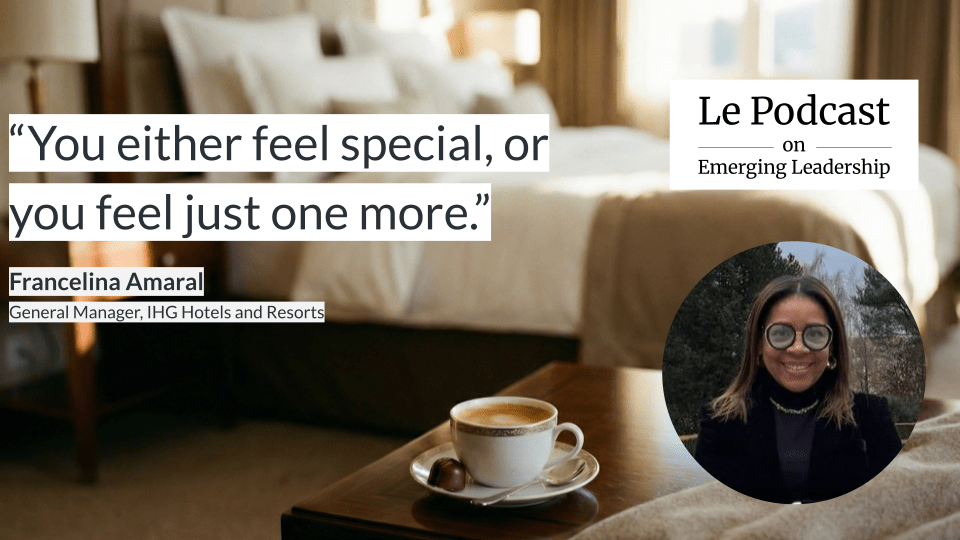
There's an example that really stood in my mind and made me shift a few of the things that I was doing in onboarding. It's what happens behind the scenes — the important moment when you arrive at a place and you feel, or don't feel, that they were ready for you, that they were preparing for you. You either feel special or you feel like just one more. You either feel connected, or you feel that nobody was waiting for you and maybe it's not the right place to come.
In onboarding we have the opportunity to make someone feel special, welcome, and to understand that we're ready to welcome this person, and that this person is important to us. At this point it's not about the position. It's about really having someone new joining — joining what I always call our family, because in hospitality we work as a family, as a team.
When I'm talking about being invisible, it's because there's so much preparation we need to do if we don't want to miss this opportunity. Everything starts before the arrival. That's why I say it's invisible. It requires preparation that starts with Human Resources, then with the manager of the department that will welcome the person, or even myself if it's someone working with me. We gather all the information, all the important things, so that from the very first contact people feel that they belong.
Alexis:
Can you share a story of an onboarding experience where you felt genuinely welcomed?
Francelina:
I'll tell you a recent one. It's not exactly an onboarding, but it is the feeling of really feeling welcome. I just moved back to France. I was in Paris from 2017 to 2021, then I left for Portugal, and now I'm back with the same group, IHG, to manage a different hotel.
The way I was received and welcomed back was the best experience. They went to pick me up at the airport, and they managed for the driver to be someone I had worked with in the past. So he recognized me. I went to do the check-in at the hotel I had managed before in the Paris Center. The general manager prepared everything down to the smallest detail: one of my preferred bedrooms, the “welcome back to Paris” note, the bottle of champagne — not to miss when you're in Paris.
All the details were so important to me at that moment that I felt like I had never left, like I had been there all the time. That is the feeling of belonging. It shows the importance of a moment like this — it can shape an experience, it can lead the experience.
Alexis:
It's really inspirational, because unfortunately I cannot tell the same story about an onboarding where I felt really welcomed. Teams lose something when they treat it just as a process. What you describe is really about how people feel — how to get them to feel that they are welcome, that they belong to that new group, even if they're just there for five minutes.
Francelina:
It is, Alex. My career started in hospitality because someone gave me the opportunity to be a trainee in one of the best hotels in London. That opportunity was given to me a long time ago and it stayed with me — to the point that every time I have the opportunity of welcoming trainees, and I see that they are really looking forward to it, not just to get a stamp on their school practice, I open the doors and I encourage all my managers to do the same.
The good thing is, when you meet these trainees at the end or in the middle of the internship and they come back and thank you for the way they were welcomed, this shows the importance of the moment, and how the moment can affect you, can shape the way you're going to be at this place — and even in your life.
Alexis:
I was lucky enough to work in one hotel you managed near Lisbon. It was very interesting to see how people handle things that could seem very simple but are not. It's not necessarily easy to park your car, it's not necessarily easy to understand how it works because you're new. I used the GPS to find the place, I finally arrive, someone welcomes me, I wonder where to park the car. They say: no, just leave it there, it's okay, don't worry. They know why I am there and everything goes smoothly. Even before I realize it, we're sitting on the terrace having a fantastic chat.
It's removing all the friction so the person can enjoy the place. It seems easy, it seems simple, but I believe it requires a high level of discipline to reach such a high level of service excellence. How do you balance the hospitality you describe with the rigor needed to achieve that level?
Francelina:
There are two important components. One is that we need to love service. We need to love what we do. If you understand that what you're doing is to bring joy, to bring experience, to bring memories to the people in front of you, then you've got it. Because if you like service, you like people, then it's an opportunity to be facing guests on a daily basis. It doesn't matter how important they are; it's about the experience that the person in front of you can bring to your life.
Now I spend hours with my clients, sometimes just listening to their stories, and I learn a lot about the world, places I've never been. So first we need to understand it's an opportunity. Then yes, there are procedures behind it, but the procedures become something you do by heart — not because you have a standard telling you “you need to park the car, you need to open the door.” It comes naturally.
Alexis:
It's focusing on how people will feel, and on how the people doing the job feel about it, and the rest comes after. It's not the opposite direction.
Francelina:
If, in onboarding, you manage to touch the person arriving — if you manage to show how much you care about them and about what they're going to give you in the future — they will give you the same type of commitment back.
I always tell my HR manager: we are your client. Internally we have requests, we have needs, we have a family to take care of. The same with our guests. They stay with us, they ask for advice on where to go for dinner. Inside a hotel there's another hotel — there's the staff canteen, the colleagues who do their best so we can have a wonderful meal inside. This is not at the eyes of the guests, but it's at our eyes. If we manage to give the same importance to that as to our guests, then it works.
It's a business, but a business where if it's our passion and we give our best, sometimes you don't feel that you're working — you feel that you're really being part of a wonderful experience. The same needs to happen behind the scenes.
Alexis:
It's very interesting that to really bring that level of care to the guests, you need to bring that level of care to the employees of the hotel.
Francelina:
It's the same. As a guest, you will feel when an employee is doing things by the book, or because they were told to, or because it's the standard — versus when they're really trying their best to accommodate your needs. Of course there's a standard, of course we cannot be intrusive, of course we have recommendations our employees respect. But a lot of the interactions — what makes an experience different and ultimately a great memory — is what they give from themselves.
Alexis:
You've helped a lot of people develop themselves during your career. What happens for them? What are the things that happen for them to start leading the way?
Francelina:
I was given the opportunity by my leaders at the time to develop myself. One of the things about me is that I'm very curious. I like to know why we need to do this, and why this way and not that way. Because I was passionate about hospitality and I wanted to understand everything.
When you have in front of you a team member who is curious, who wants to understand and learn, you have a potential leader. They will understand why we're doing things the way we're doing them, and they will share this with others. On a team you have members who give their best to the performance of the hotel and the experience of our guests, and you have members who do an extra effort and lead the process — they correct a colleague if they're not doing the right thing, they come back to you with feedback you haven't seen, they focus on details. When you see someone with these behaviors, you understand you're in the presence of someone you can grow into a leader.
Alexis:
It seems easy when we listen to this, but sometimes it's not easy, and sometimes even if you give the chance to people they will make mistakes.
I remember vividly one time I was in Spain. The table we had was not far from the bar, and we could see that there was clearly a more experienced woman talking to a very young guy who was doing the service. She was explaining something carefully and the guy was not very at ease. He went away with one bottle and two glasses, and three steps later the bottle was on the floor and the glasses were broken.
The woman went around the bar — she already had a new bottle and two new glasses. I assumed she'd go serve the customers, but she didn't. She gave the new glasses and the new bottle to the guy and said “oh, no passa nada.”
Francelina:
Nothing happens.
Alexis:
And she started cleaning up the mess. I was looking at that thinking: what just happened? The guy seemed absolutely okay after that. It happened in a snap, no shouting, no big thing. I'm pretty sure not even all the people in the room noticed something happened.
Francelina:
That's a great example, Alex. This is how you build safety, how you build confidence in the person first.
You should not shout — that's not the way people learn, and it's not the type of behavior we expect from a leader, a manager, or even a colleague. What she did was clean the situation, and give new tools — the glasses and the bottle — to the employee, not giving him time to think “I failed.” These things happen. I'm here to support.
She invests confidence. She gives him a boost of confidence saying “voilà, no passa nada, you go and do what you need to do, and I'll be cleaning up for you.” This is the foundation of leadership: when you manage to transmit confidence to your team, even though something that wasn't supposed to happen, happened.
I always say to my team: our team members are looking at our actions on a daily basis. So before being a general manager, my acts, the way I behave, is what they will see. They know I'm passionate about flowers, decoration, and details. So when I arrive in the morning and do the tour, I'll have a look at the flowers. I remember colleagues saying: “this is not in good condition, Francelina will see.” And it's true. They take care of it because Francelina will see — because they understand how important it is for the way we present our lobby or a room.
All the details count. What counts is actions — they will see me remove something that's not in the right condition to be facing the guest. What that manager in Spain did — encouraging the colleague to continue his job, removing the pressure of the situation — is one of the best examples of how to build leaders and confidence: listen, you go. This is teamwork.
Alexis:
Can you describe the moment when you see someone stop just doing their job and start really leading?
Francelina:
I believe it's when you take ownership of situations. Not only problems — situations. It's when someone goes to a colleague or a guest and says: “don't worry, I'll be taking care of this.” When you put yourself in the shoes of a guest, take the step of dealing with it, of assuming it, and saying: “I'll come back with a solution.” That's one of the first behaviors we see in someone with the potential to become a leader. When they're worried not only about the moment, but already thinking ahead.
Take the bottle and glasses example. Maybe after the incident, the person who cleaned up talks to the colleague and says: “listen, this happened because you didn't hold the bottle the way you should. I'm going to show you the most suitable way to do it.” She takes that moment of stress and pressure and makes it a moment of learning. Or, if it's not the colleague's fault, she might say: maybe we need a procedure to show everyone we cannot do it this way. That's the kind of action you see in a leader: they don't wait for a manager to come and find the solution.
Alexis:
Taking that moment as an opportunity to learn, and immediately while working on it, sharing it, refining what we can do — I love this.
There are a lot of leadership best practices in the world. We can see a lot of them on LinkedIn. What are the common leadership best practices that actually destroy belonging in reality, instead of building it?
Francelina:
What destroys not only leadership but a team is the lack of trust. The lack of drive. The lack of sharing.
When we talk about belonging, going back to onboarding or to the way you welcome someone: you need to make them feel part of the problem and part of the solution as well. They need to feel accountable for everything. Of course there are decisions held and managed by the manager or by myself. But if I share the reason why, if I share the result, then you'll have people with you.
I like to inspire. I've been inspired by my leaders, and this builds trust, confidence, and engagement. I'm sure that if you talk to my previous leaders they will tell you: yes, Francelina is someone we can rely on. Because I learned so much from them that I'm there for them when they need me. That's the role of leadership: showing the way, sharing the knowledge.
This is quite different from what we did in the past, when a general manager or HOD sat behind the desk dictating: “this is the way I want things to be done,” and no reasons why. In IHG, every general manager does it the way they believe is the best for their team, but we have a culture of sharing results, of empowering people. As soon as you are empowered, you are given responsibility, you put more of yourself, you feel that you belong, you understand how important your work is for the success of the company.
Leadership is destroyed by lack of trust, lack of confidence, the wrong way of managing things. The wrong way is when you don't share the reasons. I won't say authoritarian, but if you do it in a mandatory way: “this is mandatory, this is this” — no. Share. Listen to your team as well. Share as much as you can. A few things are not to be shared and that's okay; they will understand. Every time you can share something that affects them or helps us move forward, they will feel belonging and they will give their best.
Alexis:
Excellent. We're gently going to close. But before we close, I'll ask you a question. What is the one question I should have asked you?
Francelina:
Probably: why is Francelina, the general manager in hospitality, present on your podcast when your career has been built in different areas, not in hospitality?
Alexis:
That's a very good question. Listening to you, I was thinking: it would be so great if we had leaders in all industries behaving exactly like you describe. Because I've worked with companies where they still don't understand what good onboarding means, and what its impact is. Showing the way, going on the tour, looking at every detail, talking to people, listening to their team, working on the sense of belonging, safety, trust — they still don't understand why it's so important.
So why it makes sense to have you on the podcast: there's a lot to learn for leaders in all industries. Thank you for joining. I really appreciate it.
Francelina:
Me too. It's a moment of sharing, and I love sharing. Going back to our industry — hospitality — I felt the need to share not only my experience but what hospitality really is. At the level of luxury, yes, but luxury can be in all the details of the things we do. We don't need to be in a luxury environment. Luxury is respect. Luxury is understanding the need, anticipating the need. It's behaving.
Having your invitation to participate in the podcast is another opportunity to talk about this and hopefully inspire not only leaders or managers, but the young generation that is still figuring out if they like hospitality. If I can inspire at least one or two people with our conversation, I'm already really happy. Thank you.
Alexis:
Excellent. I love it. Thank you very much, Francelina.
If this conversation resonated with you, I'd really encourage you to share this episode with one or two people in your life — someone you work with, someone you lead, or someone you're learning alongside. Your recommendations truly matter. They help this podcast reach people who could learn from these conversations and apply them in their own context.
You'll also find the full transcript of this episode in the companion blog post linked in the description, available on alexis.monville.com.
Le Podcast on Emerging Leadership is supported by Pearlside. At Pearlside, we work with leaders and teams to create the conditions for responsibility, clarity, and impact to emerge. Learn more at pearlside.fr.
Thank you for listening.
 Castbox
 Amazon Music