 Listen on Spotify
 Apple Podcasts
In this episode of Le Podcast on Emerging Leadership, I sat down with Marcel Schwantes, a renowned speaker, executive coach, and author. With over two decades of experience helping executives transform their cultures, Marcel breaks down why the traditional top-down "boss" mentality is fundamentally broken.
Together we explore what it actually takes to become a human-centered leader, how to foster deep psychological safety, and why practicing "love in action" translates directly to exceptional business performance.
Whether you are leading a remote team, navigating the integration of AI, or simply trying to influence change within a rigid corporate structure, this conversation offers a practical roadmap for leading with authenticity and courage.
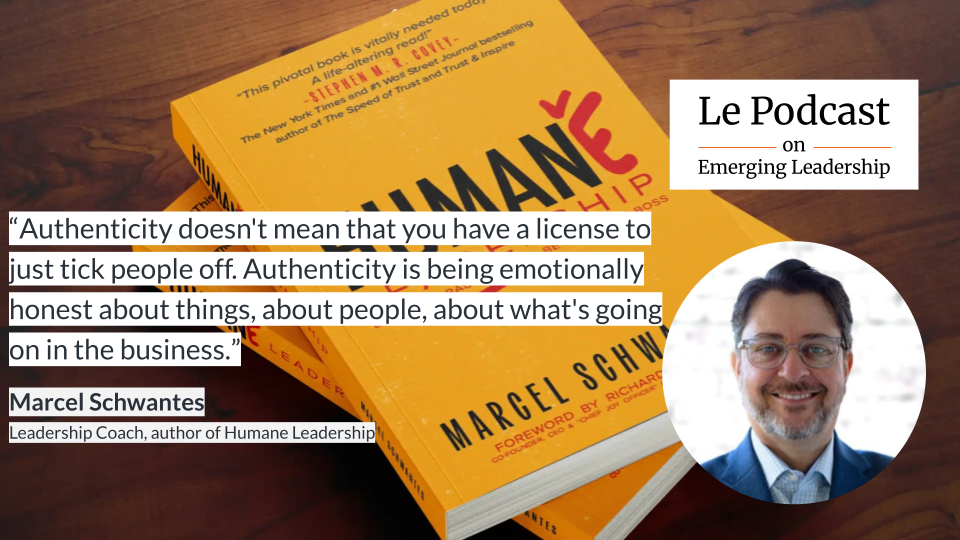
"Authenticity doesn't mean that you have a license to just tick people off. Authenticity is being emotionally honest about things, about people, about what's going on in the business."
What you will learn in this episode
- •The paradigm shift: the core differences between a traditional "boss" and a 21st-century leader
- •Love in action: what agape love looks like in a corporate setting, and why it drives engagement
- •Removing the mask: vulnerability and emotional honesty as an untapped leadership strength
- •Leading through change: keeping human connection in remote and hybrid teams, and during AI rollouts
- •Bottom-up influence: building human-centered micro-cultures that eventually transform the organization
Connect with Marcel Schwantes
Transcript
Alexis:
This is Le Podcast on Emerging Leadership. I'm your host, Alexis Monville. Today, I am joined by Marcel Schwantes, a speaker, executive coach, and author who has spent over two decades helping managers evolve from being mere bosses to true servant leaders. Hey Marcel, how do you introduce yourself to someone you just met?
Marcel Schwantes:
I would say it like this: I'm a leadership coach who teaches leaders to become more human. And if you're a CEO of an organization, it's to teach your management team or your executive team how to become more human.
Alexis:
Human leadership is more about being human than title or rank. In your observation, what is the biggest barrier that stops leaders from making that shift today?
Marcel Schwantes:
A couple of things. On a more personal, interaction basis, it's ego. We want to be in control of our destiny, our outcome. And externally, we have so much pressure now to produce short-term results that we are not thinking about how to create an environment — whether in your workplace or your business — that is actually sustainable for human beings to do really good work. Those are the two reasons that really surface for me. There are many more, but those are the ones that stand out.
Alexis:
This is very interesting. What would that mean for people to do their best work in a sustainable way? What do they need? What kind of environment do they need?
Marcel Schwantes:
I have tracked so much research, Alexis, that points to workplaces led by people who don't put people first. Managers who don't value people as much as they should, because the focus is the pressure to please shareholders or other stakeholders. Whatever business you're in — government, education, private, or non-profit — you're going to have pressures to serve other people who write your check or pay your bills.
And so I think we lose sight of what it means to lead in the 21st century. Leaders need to provide an environment where people are connecting with one another. I know this is a very overused buzzword, but they have to create psychologically safe workplaces so that people are more open, more open to collaborate, and more open to express uncertainty and even concerns about direction.
In these human-centered environments, it's safe for people to bring their humanity, and they're not going to be reprimanded by a boss who does not welcome opinions or feedback. For me, that's really flipping the script on a lot of these toxic workplaces where people have no voice, no say, are not heard, are not seen. And I point all the reasons this is happening right back up to the top: it starts with leadership. Everything relies on having a strong leadership team that has a vision for putting their people first. When you have that in place, then you can create the conditions necessary for people to do their best work.
Alexis:
Some people currently live in high-pressure environments with tough competition, and they want high performance. Do you see that on the opposite scale, or can high performance coexist with all that you said before?
Marcel Schwantes:
High performance can definitely coexist with human-centered workplaces, because you're still holding people accountable. You're still holding them accountable to excellence and to performing at a high level. But not at the expense of leaving them to their own devices, without support and without being heard.
So there's a really good balance of leadership — and I'm borrowing from servant leadership — where you have the servant part of leading, which is to take care of the people first, but not at the expense of making sure they are still held accountable for results. Because at the end of the day, we still want results. When you invest enough in people, and grow and develop them and take care of them, that's going to translate right down to their performance. That's not the reason why you do it, but it's going to naturally create some really good business outcomes.
Alexis:
You are also the host of a podcast. Can you tell us the name of the podcast and why you picked that name?
Marcel Schwantes:
There is some news here, because I just changed the name. Between 2019 and literally a month ago, I hosted the Love in Action podcast. How did I get that name? Number three on the show was Ken Blanchard, who's written a gazillion books on management and leadership. He's a big servant leadership guy, and I asked him, "Ken, how would you describe servant leadership?" I'll never forget the line. He said, "Marcel, servant leadership is love in action." That really stuck with me. So I borrowed from Ken — and I give him full attribution — for the title of my previous podcast.
Love in this sense, for those who might be misinterpreting it and thinking there's no place for love in the business world: love here is borrowed from agape love, in the Greek sense of the word. It's backed by action. It's not a squishy feeling or emotion. It's not love for your partner, your children, your dog, or your favorite sports team. It is love that is backed by action. That's how I created the framework for my book. Last month I decided to rebrand the podcast, so now it's just called The Marcel Podcast. But we still bring thought leaders, authors, scholars, and leadership experts to talk about love principles.
Alexis:
I wanted to touch on love, because for a long time I was trying to help people see that if they are reacting from fear, they are in survival mode, they are missing the connection between people. They are defensive. They want to prove their point. They cannot build together. They are alone, basically. And what I was looking at is: okay, the opposite of that, what is it? In my head it was always, "Okay, that's love." That's what wants to happen through you. And when you are there, then you can be curious, then you can ask questions, learn about other people, learn about other perspectives, build shared results, and so on.
But I was always afraid to use love in a business setting, so I was trying to go around it, saying, "We speak about appreciation, appreciate what is here, and being curious." I was always a little bit shy about it. Some people told me, "Oh, that's love," and I said, "Oh, cool." With some people it does not work as well, so I was very curious how you got there.
Marcel Schwantes:
By the way, if you look at Amazon book titles, there are close to 50 books now by business authors about love in business, love in leadership. I think the topic is starting to enter the business lexicon, where people are less afraid to use the word love, and I think that's great. That's why we need to keep creating conversations like this, to also dispel fact from fiction. There's a lot of misconception and misinformation around leading with love. People jump to all kinds of wrong conclusions and bring in religion and things that really aren't applicable to the day-to-day environment in our workplaces.
Alexis:
If we are a few kilometers apart — a few miles apart, if you prefer — on two different continents, how does it work for teams who are remote or hybrid, when there's no physical proximity? How do they build that connection you mentioned before?
Marcel Schwantes:
I don't think the requirements for leading with love or becoming a more human-centered leader change because you're working remotely. It just means you may have to work a little extra hard to make sure the conditions you would have to get high engagement and to make people feel valued in a face-to-face environment are brought into a remote setting. The point is, despite the distance, and because we're so dispersed geographically and things are so digital these days, never forget that human beings still need to be valued, seen, heard.
They need to feel like they belong. They need to feel connected. I know I'm giving you clichés, but it's true. We are wired, I believe, at the core of our humanity, to be around other people, to connect with others. So in a remote sense, how are you going to make that happen? What kind of rituals and norms do you want to start practicing and implementing as a culture to make yourselves unique? I don't know about France, but here in America we have a really big loneliness problem — and here we are, connected to our devices more than ever before, and yet we still feel lonely. We still have a mental health crisis. So we need to reimagine what it looks like in a remote setting to not forsake humanity, but to bring humanity closer together when the only means to do it is over a computer screen.
Alexis:
Maybe when you're already distributed or remote, you need to acknowledge that you will need time together in a physical setting.
Marcel Schwantes:
Oh yeah, absolutely. They do get together. They'll have their offsites three or four times a year. And that should be a requirement of the job, so people know you're not going to be hiding behind your screen all the time.
Alexis:
One part of your work is trying to help people go from boss to leader. Can you tell us a little bit more about that?
Marcel Schwantes:
Now I'm really going to speak the truth here. There's a shortage of leaders rising to the top and moving up corporate ranks. Younger generations — Gen Z-ers and maybe young Millennials — are less and less inclined to want to be leaders. In another 10 or 15 years, we're going to be in trouble. So we need to start identifying leaders and developing leaders early on, to understand what it takes. What are the metrics of great leadership? We have the business metrics every leader is responsible for: top line, bottom line, customer retention, whatever your KPIs are. That's still important.
But where we fall short is that we are promoting individual contributors to leadership roles who don't have the mindset, or even the typology, to lead other human beings. You might get a great individual contributor, a rock star, promoted to a management role, and then people systems start to break down, morale goes downhill, engagement goes downhill. So we have to look at not only who we are identifying, but what's the criteria that gets people promoted these days.
We need to flip the script from boss to leader, because boss is no longer relevant, no longer sustainable in today's human-centered workplaces. If you look at bosses historically, they've been all about themselves. Do as I say. Command and control. Micromanagers. Only thinking about the shareholders, at the expense of people. From boss to leader is really revising your inner script of what you feel leadership is and what it takes to be a good leader.
It's a good balance. You still need management principles to succeed as a leader in the business world, but too many people have the intellect, the drive, or the charisma — and maybe that's why they're promoted to the role — and then they start to show their true colors, and that's when you see systems break down, the lack of engagement, and the people side of the business suffers. We need to develop the people side of the business in others to truly understand human performance and human development. That's my very long answer to from boss to leader: we need to create fewer bosses and more leaders.
Alexis:
I love that. It means looking at other things than that simplification of what a business is — returning value to shareholders. It's a simplification. It's fairly new, and it's not what a business is about. A business is to create value for their clients or their customers, and to do that you need the people to be able to do their best work and to love what they are doing. Then the rest is a byproduct, in a way.
Marcel Schwantes:
Wouldn't you agree, it seems like common sense? You want your business to do well financially and have greater customer loyalty. Why wouldn't you take care of your people first, who are doing the work that's going to create more value for your customers and for your brand reputation? Take care of the people inside first. And by the way, here's a correlation from research — you probably know this — it's a known fact that when you take care of the employees doing the work, that's going to create more impact on the customer retention side. The experience is going to be that much more positive, and that's evidence-based. The better the employee experience, the better your customer experience is going to be. It's directly linked.
Alexis:
So basically a lot of organizations are doing things in the opposite direction. We want to get the best return, the best customer experience, at the expense of the employees. It's taking things completely backward.
Marcel Schwantes:
Right. And then leaders wonder, why is our turnover so high? Start with: who do you have as immediate managers, and how are they treating their employees? And sometimes it's not the middle manager's fault, because they are getting their orders from above. So the whole reason why people systems break down may be because of who's sitting in the C-suite.
Alexis:
But when you enter a place where this is not there, where we are still with bosses and we don't have that kind of thinking, how would you enter that space and try to influence — I don't know what is the right word — towards a more human leadership?
Marcel Schwantes:
If you are oriented to be more of a human-centered leader and you happen to be in a business environment where the people at the top don't welcome that, you can start with your own team. If you have a team of three or five or ten and you want to influence up, start being a human-centered leader within your own sphere of influence.
Here's what I found. I'll share one client organization that I coached — it was exactly that scenario. I had one manager who was totally bought in; the belief was there that human-centered leadership or servant leadership was the way to go. But nobody else bought into it, because you had the wrong people at the top constantly fighting and pulling in different directions, only thinking profit, not people. So I said, "Okay, don't wait for anybody. Go ahead and start being a human-centered leader." And he did.
The results were very noticeable. His engagement scores went up, his retention went up. There was less absenteeism — because absenteeism is basically "I don't want to go to work today because I hate my job and I hate my boss, so I call in sick." There was less of that, because people wanted to be there, they appreciated the environment they were in, and there was synergy and engagement. And that's because that one boss started the chain.
And guess who took notice of his numbers? When his retention went up and people in his department were performing, the executive team started to take notice. They wanted to find out why this manager's numbers were so different from other managers'. That created new conversations: "What's happening in that person's department? He does things a little differently." Senior leaders took notice. So talk about influence — yes, you influence the people around you, but what about influencing people up? That created more opportunities for other departments to jump on board as well and welcome a human-centered approach. All because that one person was courageous enough to start on his own, without waiting for approval from the top.
Alexis:
This is inspiring, and it's very important, because as you said, you spoke about loneliness, about mental health, you mentioned psychological safety earlier. It can start with the people who are close to you in the organization. How do you approach those topics in the organizations you're working with?
Marcel Schwantes:
Usually they come to me first. They have to be open to the idea of putting people first in order to create value and results. It becomes easier when the leader, manager, or CEO is already a champion for human-centered leadership. What you don't want is having to convince somebody who is oriented completely in the opposite direction. Convincing that person to adopt a human-centered approach when they have been a top-down autocratic boss for so long is a tough transition. Really tough.
I pick my clients carefully to make sure they have an understanding of what they're getting into when they say, "We want to create a culture that is more human-centered." Okay — what does that mean to you? I want to be able to listen and make sure they really know what it's going to take, so that this thing doesn't blow up if they have a misconception of what it is. A lot of times you read about it in the media, you listen to a podcast, you watch a TEDx talk, and you're like, "Hey, this is cool, we need to bring this to our organization." And yet your inner orientation, your natural tendency, is still to squash people.
So I want to make sure it's not surface-level ideology, or the impression that a competitor is a human-centered workplace, therefore we need to be as well. It takes belief first. Why do you want to be a human-centered leader or organization? That's the first question I always ask, and I really tune in to make sure they have the right priorities in place.
Alexis:
It's fascinating, because then we have that idea that they need to believe, and they will probably need to change the way they behave. So as you mentioned before, it's not only about managing others, it's about managing oneself. Do you feel it happens often that they realize it starts with them, or at least that they are part of the picture, and it's not only the other people?
Marcel Schwantes:
Once they realize that what has worked in the past is no longer sustainable, that what they picked up from previous bosses no longer works in this age of connection and belonging — once they get past that, I think it's an easier transition. These leaders point back to their values, their value system. So many of them realize that all their outer success, all of the output, is no longer congruent with who they are internally, with their values.
That's a real shift, and I've seen it. It's a big aha moment for a lot of leaders to realize, "I'm no longer living or working or leading through my core beliefs and values." There is that disconnect. And so they begin to reinvent themselves through self-leadership. What does it look like for me to live with more honesty, more integrity? What does it mean to work in places where I may have to be the bad guy because I'm speaking truth to power? I may not be the most popular person when I speak my truth.
And that's very human-centered. You don't beat around the bush — I'm using all these American clichés, by the way. You just speak your truth and people know where you stand: this is where we're headed, even though these are uncertain times, but I'm going to be there with you every step of the way. We're going to figure this out together. These are all things that bring you back to your own humanity. Operating from your value system is really key to making that shift with others — to lead yourself first, by your values, in order to then make an impact on others.
Alexis:
So in a way, some people realize that for some time, maybe years, they were wearing the mask of the boss. And at some point they realize that if they really want to shift the whole organization, they need to remove the mask and be themselves. Is that what you're saying?
Marcel Schwantes:
Yeah, and it's funny that you use removing the mask — I use that a lot in my courses as well, because one of the things I teach is authenticity. How do we become more authentic as leaders? Talk about being human-centered: first you need to remove your mask. So many of us walk into a workplace and we check our real selves at the door and put on the mask to portray somebody that may not be who we truly are.
And authenticity doesn't mean you now have a license to just tick people off and say whatever is on your mind. No, that's not authenticity. That's being a jerk. Authenticity is being emotionally honest about things, about people, about what's going on in the business. You communicate emotionally honestly about the good things that are happening, so that you celebrate as a team, and also about the uncertainties, the things that may bring people fear.
You want to be there to calm the waters, not give all of these ambiguous speeches and messages. Tell people what's really going on. That's being authentic. You're going to earn their trust much more when you just tell them what's really going on, instead of hiding it because you want to save your reputation, or because you fear your boss saying, "Hey, if we tell our people what's really going on, it makes us look weak."
No. Vulnerability is a leadership strength that is untapped, and if more leaders can figure out how to exercise this authentic vulnerability — especially in times of change, transition, and uncertainty, God forbid we have another COVID — that's when we need to rise up and become more authentic. Even today there are a lot of struggles and challenges going on.
Alexis:
I have one for you. You will love it — I already know it. I will drop just two letters, because you spoke about fear and high expectations: AI. What does it mean for leaders, for human-centered leaders?
Marcel Schwantes:
We have to learn to embrace and adopt AI. Absolutely, we need it. It's here to stay. But we also have to empower the people with the technology. As we have more AI initiatives, leaders have to understand that we need to take care of the people too. If we want them to use AI, you need to set the right expectations for why they're doing it, and remove the fear of "oh gosh, my company's bringing in AI, there goes my job."
And if that's your ulterior motive for bringing in AI, this is the wrong podcast to listen to. If you've already made up your mind that you're going to let go of 30% of your workforce because of AI, the human-centered conversation is worthless here. But if you're going to bring in AI, you're going to have to help the people adapt to it, know how to use it, and build the idea that they're not going anywhere. We just want to make you more effective, more productive, and a better human being with the use of AI. We're going to teach you everything you need to know. We're going to upskill you, and even give you the freedom to create, to experiment with prompts, to redesign your own work if it makes business sense — and then tell us, teach us leaders, how do we do it? How do we become more effective? That's creating more value and bringing humanity together with technology.
Alexis:
And we still have a lot of problems to tackle as human beings on the planet. There's no shortage of problems to solve, so maybe that's a good thing. Okay, that was my AI question, I'm not going back to it. What is one question I should have asked you that I did not?
Marcel Schwantes:
I would say: if I wanted to build a human-centered organization, and I'm a firm believer that this is going to work, and I want to be a champion of this — what's my first step? That's the question, because a lot of leaders get so caught up in strategy and big-picture stuff that we forget about what's going on in the trenches. What are people experiencing?
So the first step is to gather the data you need to first understand your current reality. What are people experiencing? Go ask them. Have your managers ask them. Bring in a consultant if you have to, one of us. First understand what you're dealing with. What are our barriers, our obstacles? Because you're going to find them. As soon as you start poking around, you're going to get themes rising to the surface, and that's your starting point right there. Now you can go from, "Okay, here are problems A, B, C, one, two, three," to "Here's how we create a human-centered culture to address those problems."
Alexis:
I love it. Thank you for that really good question. And of course, thank you Marcel for having joined the podcast today. I really appreciate it.
Marcel Schwantes:
It's been a pleasure, and I was looking forward to it.
Alexis:
Thank you for listening to this episode of Le Podcast on Emerging Leadership. I hope you found today's conversation as insightful and inspiring as I did. If you want to dive deeper into the topics we discussed today, you can find the full episode transcript and all the references by visiting alexis.monville.com.
Leadership is a continuous journey, and it is one best shared with others. So if you took away something valuable from today's episode, please take a moment to share it with a friend or two who might also benefit from these insights. This is really appreciated. Until next time, keep learning, keep adapting, and keep leading. I'm Alexis Monville, and this has been Le Podcast on Emerging Leadership.
 Castbox
 Amazon Music