 Listen on Spotify
 Apple Podcasts
Some episodes give you a framework. This one gives you a practice.
I sat down with Jeffrey Fredrick, VP of Engineering at Ion Analytics and co-author of Agile Conversations, to explore what happens in the moments that matter: when tension rises, stakes feel high, and the conversation goes off the rails.
What struck me is that Jeffrey does not talk about communication as "soft skills". He talks about it as deliberate practice — and offers a simple, repeatable cycle to make it real.
In this episode, we discuss
- •The CitCon moment that started it all: "You're good at advocacy, but where is your inquiry?"
- •The Four Rs — Record, Reflect, Revise, Role play — turning insight into deliberate practice.
- •Why we don't remember what we said: hearing the music in our head instead of the tapping.
- •Trust first, fear second, then why — and why hiding your concerns is withholding relevant information.
- •Naive realism, loss aversion, and the trap of trying to win instead of learn.
- •Triggers, tells and twitches — spotting your patterns and pre-planning your moves.
- •How mutual learning spreads in an organization — one person, and one ritual, at a time.
References mentioned in the episode
- Agile Conversations — Douglas Squirrel & Jeffrey Fredrick
- Chris Argyris — model one (unilateral control) and model two (mutual learning)
- Nonviolent Communication (NVC) — Marshall Rosenberg
- LEAP model — Xavier Amador
- CitCon — Continuous Integration & Testing Conference
Transcript
Alexis:
Welcome to Le Podcast on Emerging Leadership. I'm your host, Alexis Monville. Today, we are diving into the world of agile leadership with a special guest, Jeffrey Fredrick. Jeffrey is the Vice President of Engineering at Ion Analytics and the co-author of the book Agile Conversations. With a wealth of experience in the tech industry, Jeffrey has a unique perspective on how agile can transform teams and drive innovation. Welcome to the podcast, Jeffrey. How do you typically introduce yourself to someone you just met?
Jeffrey:
Well, I had lots of practice the last couple weekends being at a couple of conferences. So I got to refine my pitch. The usual way that I put it is I work four days a week as a software executive, currently VP of engineering, and then one day a week as an executive coach, both to individuals and to executive teams.
Alexis:
Wow, that's a perfect pitch. I love it. And I like the balance between the four days a week doing the job for real and one day a week helping others do it. That reminds me of something. You are also the co-author of the book Agile Conversations. Can you tell us about the pivotal moment that led you to the book?
Jeffrey:
Oh, well, in a sense, I think the pivotal moment came for me actually at a different conference, at CitCon, the conference that I organized and have organized for the past 19 years. I was there and I was talking to someone who I just met, a gentleman named Benjamin Mitchell, and we were talking and he said something very strange. I didn't understand what he meant at first. He said, well, you seem very practiced, very skilled at making the case for what you're saying. He said, you're very good at advocacy, but I'm not hearing much inquiry. And I was very confused by what he said. He clearly meant something very particular, but I didn't know what it was, and that really was my very first taste of the model from Chris Argyris — what he would call model one and model two — easily understood as the unilateral control model and the mutual learning model.
One of the ideas in it is that you should be balancing advocacy and inquiry. You should be both making the case for what you believe and sharing the reasons why you believe it. And you should also be curious about the other person's beliefs and why they believe what they do. So it was actually that conversation that ended up setting me down the path that led to the book. The gap between that conversation and the book was about nine years. So it wasn't a quick path, but it was actually fairly direct.
Alexis:
I love the story. When I read the book I was thinking, okay, it sounds very simple at first. You're talking about the four R's and I will ask you to explain that a little bit, but if you want to practice it, suddenly you'll realize that you will need a lot of practice. Can you give us a taste of what the four R's are?
Jeffrey:
Sure. The four Rs actually came about from trying to teach others this model. I started learning Chris Argyris's material, I started practicing it myself, and I was very fortunate to be in a study group with the aforementioned Benjamin Mitchell and Douglas Squirrel, my co-author. We would have long weekly sessions where we would study it. And then I tried to bring the same material into the workplace and have other people learn it as well. We weren't going to be able to have multi-hour conversations. So what I needed was a format that would allow us to get a lot of the same value of practice, but in a shorter timeframe.
The four R's are a process for studying really any kind of conversational technique. There are lots of different models of what good communication looks like — the Chris Argyris mutual learning model, but also nonviolent communication, Xavier Amador's LEAP model, many different things people might want to check to see if they're doing. The four Rs in a sense is separate from all of those. It's a process of studying conversations. The four steps are: first you Record your conversation, in a two-column format — and the two-column part is important. Then you Reflect: this is where you bring whatever model you're using to bear, and you evaluate your conversation according to the model. Having reflected, you Revise: you try creating an alternate version of the conversation. These two steps are really where the practice is — up until now you've been evaluating what you've done, but it's really in the work of trying to improve as the element of deliberate practice. Once you've written down a version you prefer, you go to the final step: Role play — actually saying things out loud that you have written down. There's a loop here: you might not like your first revision, you might not like what it sounds like when you role play. You go back and re-revise and re-reflect. Even in the role play, you might change sides with the person you're practicing with — that's role reversal.
Alexis:
It's very powerful. And just the recording phase is very interesting. I usually take notes when I have a conversation with people, but I realized when I was reading the book that I usually take notes about what the other person says, not so much about what I say. And when I recall the conversation, usually I don't really remember what I said. There's a few things that I note, but it's basically things that I want to remember — I gave that advice or I asked for a particular thing — but all the rest, I forget about it. I was stunned by that. Is it something you observed?
Jeffrey:
Absolutely. It's not surprising that we don't remember what we said exactly, because in practice we aren't aware of what we say in a conversation. This is why people have difficulty improving their conversational skills without this kind of deliberate practice and writing things down.
One of my favorite experiments about this: they asked a number of people to tap out a tune, one that was very familiar — say, Happy Birthday To You. They would tap on the table, and then they would ask people what are the odds that the person listening will be able to guess what was being tapped. People give a whole range — 40%, 20%, 10%. Actually it's much smaller — something like less than 5% of people could guess. Why? The person doing the tapping isn't hearing the tapping. They're hearing the song playing in their head. They're hearing the music in their head. And that's what we are like in our conversations. We aren't hearing the words we say. We're hearing the music in our head.
There are actually two completely different conversations happening. There's what we're hearing in our head, and the person we're talking to — all they hear is the tapping. That gap explains a lot of our conversational differences. What the four Rs do, in the recording format by having one column where you write down your thoughts and feelings and one column where you write down the actual dialogue, is they make that difference clear.
Alexis:
I love the analogy and I'm eager to try the experiment. I'm pretty sure that all listeners Start With Why. And still, I tend to agree with you that it's not really where to start. Why are you saying that?
Jeffrey:
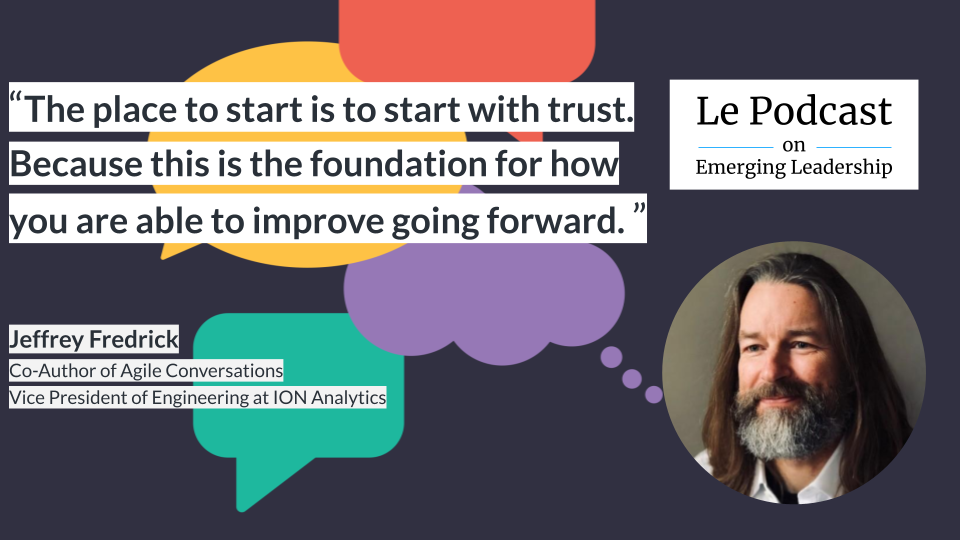
It's worth saying that in the book, when we lay out the conversations we believe a team should be having, it really comes down to what we value more than why. Why is still important, but we put it third. Before you start getting into why, the place to start is with trust. Because that's the foundation for how you are able to improve going forward. If you don't have trust, then the future conversations are not going to bear any fruit.
The idea of how you build trust generically — I've only come across one way to do it, which is in some sense to be vulnerable. Being vulnerable means sharing our thoughts and feelings and being interested in the thoughts and feelings of other people. This is not the kind of trust or being vulnerable from a traditional leadership game of trust falls. This is something a little bit higher stakes — being willing to share differences of opinion when you're not sure whether you're going to agree.
If you have the inner thought that says, that's the stupidest idea I ever heard, building trust doesn't mean saying, wow that was the stupidest idea ever heard. But if you say, well, I have some concerns, great — full marks. If you just say, oh, okay, then clearly you're withholding relevant information. That's the low-trust building approach.
Our second conversation is having the fear conversation. That's an extension of building trust, because if we're not sharing our fears, we're not really being vulnerable. One of the big barriers to good conversations is naive realism — the cognitive bias that says: I see the world as it is, and so do you. We're both looking at the same objective reality, therefore we have the same information. If you don't agree with me, you must be confused, and my job is to explain that to you. In that world, we don't need to talk about our fears because they're obvious. If we leave that mistaken world and recognise we're seeing different worlds, then the need to actually explain our fears becomes more apparent. People tend to have a negativity bias and loss aversion — negative emotions have a stronger influence on us than positive ones. So we think addressing those hidden concerns first is important before getting to the more positive side, which is why and what we hope to achieve going forward.
Alexis:
I really love the way you are framing it about withholding information. I feel it's very powerful. If you ask me to be vulnerable, there's some discomfort with that. And now if you're telling me, oh, but if you want to make progress in that relationship, in that conversation, you cannot keep information to yourself — you have to open up a little bit to help the other person see what you think, see what you fear — I believe it's very, very powerful to frame it this way.
Jeffrey:
Yes, I'm glad that resonates with you. One thing I'll say is it resonates with a lot of people. One of the dangers our book is actually trying to address is that when you read these types of ideas, they all make sense. The challenge is that they make so much sense to people that not only do they agree with them, they believe they are already doing them. The purpose of the four Rs, the purpose of writing things down, is to allow us to observe the fact that we don't behave the way that we espouse, the way that we value. We believe this to be the best way to communicate, therefore that must be how we communicate. But when we look at the evidence, unless we've done some very deliberate practice, that's not the way we actually behave by default. When we are more strategic, we fall into what Chris Argyris called model one — the unilateral control model — and we end up withholding information, not by deliberate strategy, but because it's the way we've been trained and the way that feels natural.
Alexis:
I love the idea of identifying the triggers, because they are derailing the conversation completely. It's very interesting to reflect on that and say, okay, let's pause for a second on that one, let's avoid the hundred-percent reaction mode and spend a little bit more time on it.
Jeffrey:
That's right. We talk about triggers, tells and twitches — three types of patterns we can learn about ourselves through doing multiple conversation analyses. If we do it multiple times, we'll spot these patterns and realize the way we often behave. Then the idea is that having discovered that, we come up with pre-planned strategies — things we've decided in advance that agree with our values — rather than trying to improvise in the moment under pressure, in which case we're likely to fall back to those default model one strategies.
Alexis:
So you are VP of engineering at Ion Analytics. Are you really able to use that in your day-to-day life and how are your teams using it?
Jeffrey:
Not all of the teams use it. I use it all the time. If nothing else, I do a workshop every month at the Agile Conversations meetup — it's open and free to everyone. So minimally I do this practice once a month. I actually did something like this four or five times in the past week leading different workshops at conferences. So you're catching me in a moment where I look especially virtuous in practice. I will definitely use these techniques of practice even though I've been doing it for ten years — actually more like 12 or 13 years now. It's still very valuable to keep practicing.
The thing about these skills is that there are things you can initiate. These are practices you can do on your own without needing to get everyone's buy-in. These ideas of being more transparent and more curious work whether or not other people have practiced them as well. We're not trying to do something wild and crazy. I often illustrate this in group sessions: if I was going to put you in charge of coming up with a process to make a decision — let's say what ice cream we ordered tonight for the group — how would you suggest we go about making the decision? It's generally some variation of: well, I would ask everyone for their idea. Cool — so you'd be curious. Would you also share your own ideas? Yes. So you'd be transparent. Everyone agrees that we're going to make a decision together, we want all the information, so we should be curious about what everyone else knows and transparent about what we know. We all agree that's the best way to make a decision. But it's not the way people act in practice if they think something important is at stake.
This is why people make great facilitators for other people's problems — because they don't care, and when they don't care, they naturally act productively: let's get all the information on the table, let's hear from both sides. We deeply believe this is the best way to make decisions. But if we think something important is at stake, suddenly we don't behave that way. The reason is we come up with our own ideas about what we think is best. And once we have our own idea of what's best, suddenly we want it to win. We're no longer trying to make the best decision. We're trying to have our decision be the decision. That approach leads to a completely different set of behaviors. It's not a conscious choice — it's a function of how our cognition works. Going back to naive realism: the right answer is obvious, therefore I just need to bludgeon people with reason until my way is victorious. Going along with that is the idea that this is the right thing to do. It's that fear of loss that generates these behaviors. It's not that people are ill-motivated, but the way our cognition works gets us caught in this trap.
This is why it's really valuable to practice this other way of being — focusing on mutual learning rather than on having our idea win. How can I focus on learning what other people believe and sharing what I believe? At the end, maybe we won't agree on the best thing to do, but at least in our disagreement we'll have all available information. This works without other people being trained in it, because if I come to you and say, look, we have this decision to make, but I really want to understand, Alexis, what is it that you believe and can you tell me what you saw and how you got there — you're happy to tell me. You're quite happy to share your chain of reasoning because you'll be persuasive. And if having done that I share what I've seen and how I got there, people are generally happy to listen after they've had their chance to talk. When we've done the practice and can behave this way, we make the whole conversation better for everyone.
Alexis:
Very interesting. So do you believe that drives the way the teams are organized, the way the team works, because you and probably others start to behave that way, engaging people and their interactions?
Jeffrey:
The conversations I'm part of, I can bring these skills to and make better. The more people who've done the practice, the better. I'm at Ion via a series of acquisitions. When I first was learning this, I was CTO and head of product at a much smaller company called TIM Group. At TIM Group we did bring this material in, and we did have everyone in the company practice. It was very effective to have everyone learn these skills because you start having the kind of jargon that really did accelerate things — you could be much more transparent about your meta-thoughts: well, let's make sure that we're using mutual learning here. People would do practice sessions together. We had a weekly and later fortnightly practice session where people would bring their conversations for group discussion. It was very valuable. It would be really interesting when two people would bring their own conversational analysis of the same conversation. People consistently realized that if they'd been more transparent and more curious earlier in their conversations, things would have gone better. They often were bringing cases where they had long debates with each other before eventually settling on something. In one sense they didn't really need the skills — they would work things out eventually — but having the skills, what would have been three hours of discussion became 10 minutes. And people felt better. There's definite wins for having done this as a group. It's not required, but it's an accelerant if you have more people on board.
Alexis:
What is the size of Ion Analytics and Ion Group in general?
Jeffrey:
Ion Group is tens of thousands of people. Ion Analytics is a couple thousand. Within engineering we're talking 250 to 300. So it's a much larger organization than when I was at TIM Group, where when I started there were 120 people.
Alexis:
That gives a sense that we're not talking about 10 people or even 100 — it's way larger. And you can still see the impact of having better conversations in the organization. Is it something that can spread to the other parts of the group, or is it only in your area?
Jeffrey:
I think it spreads individual by individual. Even back at TIM Group, it started very much within engineering. It was people within engineering who were practicing these things, then product, then people in data science, until it was all of the technology side, and then it spread over to the executive team. Then the executive team wanted to instill it in the rest of the company and took it to sales. It did spread bit by bit, because you had people who were explicitly championing it.
Within the context of Ion Analytics, it's something I focus more on using than teaching. I've done some classes, but we don't have the same kind of weekly study group at the moment. There is an element to which it spreads even though there's no training. If I'm with a group of people and we practice the idea of being transparent and curious, they begin developing those patterns and it comes out in some of the ritualized elements. For example, we're focused a lot right now on post-mortems or root cause analysis, bringing in the idea that we're going to focus first on creating a timeline — we want a head of shared facts that we're discussing before we then go and try to make meaning from those facts. We're going to move stepwise and have multiple people involved sharing their perspective. We're embedding in the process this mutual learning model. So it spreads through experience rather than through a shared mental model. That does spread in part because, going back to what I said before about the need to build trust, when we have built trust with other people and have psychological safety, then we are more likely to behave in the way we believe is correct — to be vulnerable and share those differences, and to be curious about what other people say.
Alexis:
I love it. Thank you very much, Jeffrey. Maybe one last question — what would be one piece of advice you would give to your younger self?
Jeffrey:
The advice I'd give to my younger self is to start this earlier. I'm now 54. I came to this in my forties and it would have made a massive difference if I had started this in my twenties. I could have learned a lot more, a lot faster. I could have been much more persuasive. I could have been much more help to the groups I was dealing with, if I had learned these skills earlier. I definitely was the kind of person who would try to persuade other people about why my position was right. Benjamin Mitchell was correct in his analysis — I was well-practiced at advocacy. That was true. I had a couple decades of serious practice, going back to high school speech and debate team. Three decades of persuasion. I would have benefited from a lot more curiosity. So my advice to my younger self would be: become more balanced, learn the value of listening first, and understand that listening is not a weakness — it's a strength. There's that element of: if I'm curious, I'm somehow losing ground. That's simply not true. I'm adding value to everyone by being curious. And then I'll have my opportunity to be transparent. That's advice I could have used a couple decades before I learned it.
Alexis:
I love it, Jeffrey. Thank you very much for having joined me on the podcast.
Jeffrey:
Thank you for having me.
 Castbox
 Amazon Music