 Listen on Spotify
 Apple Podcasts
When engineering systems grow large enough, leadership stops being about control. That is one of the strongest messages from my conversation with Tamar Bercovici, VP of Engineering at Box.
Her team supports a platform used by tens of millions of users and stores massive amounts of enterprise content. At that scale, leadership becomes a different discipline — one of clarity, context, and continuous de-risking rather than direct intervention.
We talk about her two big career transitions, leading multi-year cloud migrations, why risk is not the problem, and how generative AI is reshaping what a content platform can do.
In this episode, we discuss
- •Leading a core platform team of under 200 engineers serving tens of millions of enterprise users at Box.
- •The two big career transitions: from individual contributor to manager, and from managing teams to managing organizations.
- •Why a shared why and a clear next milestone scale better than control at large engineering organizations.
- •Leading through change without sugarcoating or venting — owning the difficult message and showing the path forward.
- •Lessons from running multi-year infrastructure migrations, including a full move from on-prem to the cloud.
- •Reframing risk: anything meaningful is risky, so name the risks explicitly and de-risk early and continuously.
- •Innovating on top of foundations — what generative AI changes for a content platform like Box.
- •Careers as iterative systems: make a choice, learn, adjust, and don't carry the emotional weight of irreversibility.
References mentioned in the episode
Transcript
Alexis:
Welcome to Le Podcast on Emerging Leadership. I'm your host, Alexis Monville. In today's episode with Tamar Bercovici, we're diving into the art of leadership within the tech industry. Tamar, VP of Engineering at Box, has led her team through groundbreaking transformations, blending the art of building high-performing teams with the science of developing innovative technologies. Join us as Tamar shares her journey from a software engineer to a visionary leader at Box, revealing her strategies for building teams and steering her team towards continuous innovation. Welcome Tamar. Could you share how you typically introduce yourself?
Tamar:
Hi, it's wonderful to be here. My name is Tamar Bercovici. I'm a VP of Engineering at Box, where I lead the core platform. At Box we're building out the content layer for the enterprise, and the core platform is the underpinning of our product. So a lot of distributed systems type challenges, high-scale challenges, but also the backbone for the product — thinking about what the right abstraction layers are. I've been at Box for 13 years. Yeah, that's me.
Alexis:
Excellent. So what drives your passion for technology and leadership?
Tamar:
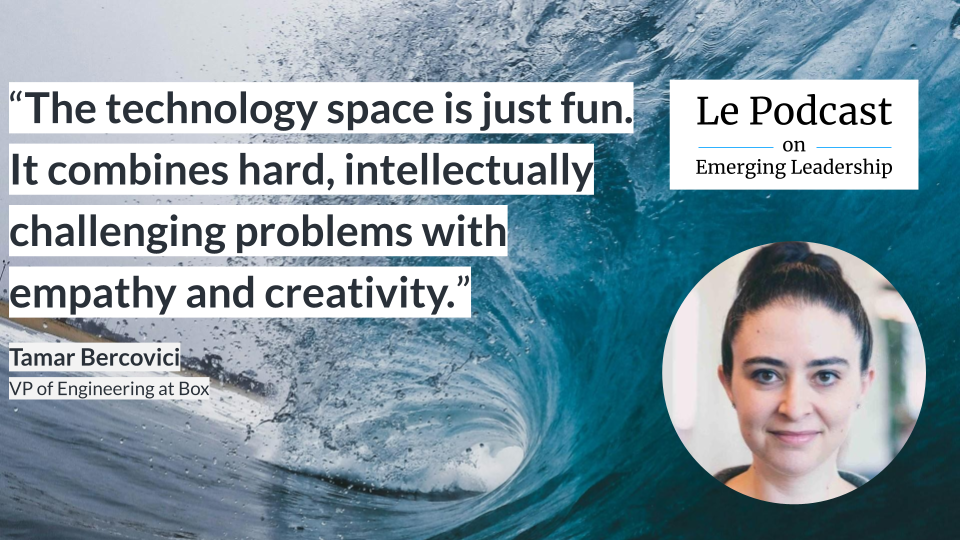
I think the technology space is just fun. It's a really unique combination of hard, interesting, intellectually challenging problems combined with a lot of customer empathy and human empathy and a lot of creativity. There's a really unique mix where we get to think about problems from a lot of different angles and a lot of different perspectives.
And then leadership is something that, at some point in my career, I shifted into a managerial position sort of as an experiment. I learned that there's something very compelling about teams and how you bring people together and align their energies and their passions and their talents to accomplish a goal together. It's a really unique type of challenge in and of itself. But there's also something very gratifying about working in that way. Being in a leadership position enables me to create that for myself and for my team, and it's something that I've really enjoyed over the past years.
Alexis:
Give me a sense of the scale of what we are talking about. What is the size of your team? And how many users do you have?
Tamar:
Box focuses primarily on enterprises, on businesses. We have businesses all over the world as customers — all different industries, all different sizes, from very small companies to some of the largest organizations. The users are the employees in those companies that have seats at Box, plus individual users as well. In terms of the scale of users, it's in the tens of millions.
But some of the interesting elements of the Box platform specifically is the scale of content that we store on the platform. We're probably running one of the largest content stores on the web, and that has a lot of interesting challenges — straight up in the storage itself, uploads and downloads, managing copies and encryptions. And then the system and the product, the metadata around that, that enables the product experiences, is an interesting scale challenge as well.
Alexis:
With users in the tens of millions, what is the size of the team managing that core platform?
Tamar:
We run a relatively lean engineering team, I think, for the scale of the company. My team specifically on the core platform is just under 200. And that's for all of those core parts of our infrastructure — the storage infrastructure I mentioned, our data stores, eventing systems, search index, metadata stores, and then the core backbone business logic layer. Recently, AI platform thrown in there as well. So a lot of those fundamental components. And then within Box engineering more broadly we have teams focused on the pure infrastructure layer, plus all the teams that build out the product experiences themselves.
Alexis:
I still find that incredible — that's a very small team compared to the challenges. Tell me more about your transition from individual contributor to a management role, and the pivotal moment in the decision to do that.
Tamar:
I joined Box as an engineer, coming off finishing a PhD in theoretical computer science. My goal at the time was to get back into industry, get back into a startup environment. After joining as an engineer, my first biggish project was around building out the initial scalability layer for our database infrastructure.
One of the interesting things that you go through in an early-stage company is you shift from very generalized roles to incrementally more specificity in what you own. I joined a six-person backend engineering team that kind of owned all of it. As the company was scaling and we had to scale out the infrastructure to support that, you're now building more complex systems. There's more value in investing in those systems, but you also increase the complexity, and you need people who specialize in the system. So you go through this process of suddenly having differentiated teams.
I had been a part of that database project that shifted us from a very simple, single database to a somewhat more complex infrastructure, and I was faced with the decision point of staying on the technical track or trying my hand at management. I debated it a fair amount. It felt more consequential at some level than it should have, because honestly this is the kind of decision that you can undo. I've had multiple people who shifted into management and then decided at some point that that was no longer the path they wanted, so they went back to being individual contributors — and that experience actually gained them a lot of insight and perspective on what it takes to lead a healthy engineering team.
At the end of all that debate, I decided that management was going to be a bigger departure from what I had done so far, and I was curious. I wanted to try it out. That initial transition is awkward for almost everyone I've ever talked to or managed who was going through it — and definitely for myself. You need to redefine what your job is and how you assess your success or failure. It becomes a little difficult to separate yourself from the people on the team that are doing the work. But once I wrapped my head around that, I really enjoyed it because it let me look at the same set of problems from a more well-rounded, multiple-angle perspective.
And then I think the second big transition is further on, when you shift from managing teams to managing organizations. Understanding what that requires and how you need to shift what you do and what you hold yourself accountable for — it's again, to some degree, a different role. Those were the two big moments.
Alexis:
Excellent. Can you discuss some strategies you've employed to foster a thriving engineering culture?
Tamar:
The first thing is, you have to work at a company — as a leader in particular, if you're not the CEO who's setting the tone — where your values align with the culture, because as a leader it's really important that you are modeling and reinforcing that culture. Finding a good place to work is key, so the investments that you're making are synergetic with what's happening more broadly within the company.
At the end of the day, what do good employees want? We want to be challenged and have opportunities to grow. We want to work with a good group of people. And we want to make sure we're having impact — that our work matters. You want to understand why what you're doing is important, because every job has the exciting bits, the challenging bits, the flashy ones, and then the more run-the-business or less exciting aspects. You have to be motivated by the importance of what you're trying to accomplish.
So as a leader, you set that good cultural DNA and reinforce it from yourself. But then you also make sure the team has a compelling goal or set of goals to strive for, and that people really understand how what they're doing fits in with what we're trying to accomplish as a business. That's how you get engineers — or whatever role they're in at the company — that understand what we're trying to accomplish and can make better localized decisions, feel more empowered, be more engaged and actually deliver better results. That alignment of what we're doing to business impact sounds straightforward, but it's very foundational.
Alexis:
I assume that, as for a lot of people, managing through changes can be challenging. Do you have examples that were really challenging, and what have you learned through them?
Tamar:
A lot of leadership is leading through change. Our organizations are very rarely stagnant. There's an evolution of what we're trying to solve for, what our goals are, ups and downs in the business that you need to contextualize, as well as massive challenging projects that cause big shifts. Whether it's corporate context or people, HR, process, or technology, at some level a lot of that is what we do as leaders.
There are some commonalities for all of those. You have to understand whether you're driving the decision or whether the change is being pushed on you — either way, you have to make it your own. You have to understand why we're doing what we're doing, why we need to make this change, and what we're solving for, so that you can be very transparent with the team. Change is always uncomfortable; we all have a little bit of that reaction of "oh, what's happening, I feel unsettled." Having that context on why we're dealing with this problem is really important.
And then, in particular if it's challenging, striking that balance of making sure you're not sugarcoating and glossing over the critical parts, but also that you're not over-empathizing with the negative and effectively venting or ranting to your team. You have to own the difficult message if it is difficult, and then show why you're optimistic that we're going to navigate this change successfully — what we need to do to make it work and what your expectations of the team are.
I've had the opportunity at Box to lead us through several big infrastructure migrations — very large-scale efforts. We had some that shifted between various on-prem data center environments, which is still a quite complex endeavor. And then more recently we completed a full migration from all the workloads we had on prem into the cloud. That's something where you need everyone across all of their different services and tool sets and libraries and corpuses to figure out the right set of things to do locally, while also having it be part of the overall migration cadence.
It has to start with a ruthless clarity of goal. Everyone needs to know what we're trying to accomplish and why, so that as they make localized decisions, they make them in a way that's synergetic with the overall goal. There's no way you can go control every little last thing that hundreds of people are doing — even 30 people, I don't think that's feasible. So definitely not a whole organization. Having that clarity of goal, and then clarity of any interim milestones we're trying to hit as a team, simplified to the point that if you stop someone in the hallway and ask them what the next milestone is, they'll know — that gives you the confidence to trust that we're building a high-performing team across the floor. If people know what they need to solve for, they're more likely to make those good localized decisions, and then it all connects together.
Alexis:
I really like how you framed it. There's the need to understand why we're doing something and to own it and make it your own — even if the change is pushed on you. And to make sure everybody knows why we're doing it, what we're aiming at, and the intermediate milestones. That will really enable decisions by the people doing the work. There's a lot of things to connect there that are really important.
Tamar:
Yes. You want to increase the chances that all the decisions being made — you scale out by enabling people to make good localized decisions. You do that through context, through that high-level drumbeat, and through a lot of communication. Of course, there's more to this — you need to have some signals rolling up to tell you how things are going so that you know if a particular area is falling behind and maybe you need to dive in more. It's never as simple as it sounds in the podcast.
Maybe one more thing I'd call out in the context of any large-scale change: they're always risky in some way. There's some element of risk on whether we'll be able to successfully make this change and whether it will have the impact we expect. Sometimes people interpret the risk as a sign that this is a bad idea, or they make plans that assume no risk and then say "this plan is at risk because there's a lot we don't know." There's a kind of handling of risk that's maybe not what it needs to be.
It's important — and this is something you can do as a leader — to take a step back and say there's nothing of value that is without risk. So the fact that there is risk is not a problem; we know this is risky. We have to ask ourselves concretely: what are the risks that we're concerned about? Once you've called out the risk, you make a plan to de-risk. It's not about knowing everything. You assume there's an ongoing level of risk you're managing, but managing risk is not just acknowledging that it's there — it's figuring out how to de-risk as soon as you can. Is there a POC I can do? An initial test? A load validation? An integration point? A user study, customer test, design partner? If I'm rolling out a process change, can I roll it out with an individual team to help iron out the kinks?
If you have clarity of goal, and clarity of everyone within their own areas de-risking towards that goal — that is the best way I know of to increase the chances of successfully hitting the outcome you were hoping for.
Alexis:
I really love that idea — there are things you know, and you need to make sure you know why you know them, and there are things you don't know, and then you need to conduct experiments so that you know a little bit better those areas you don't know. That's perfect. Looking ahead, what are some of the key areas of focus for you and your team, and how do you plan to continue innovating?
Tamar:
There are some areas that are almost a constant, and that's a good thing. If you're running any kind of large-scale infrastructure platform, you're always thinking about performance, availability, efficiency — all of those fundamental, foundational components. Hopefully you're always thinking about them because the scale of the business is growing, the scale of the customers is growing, and especially in an enterprise context the type of work they're trying to do on top of your platform is becoming more sophisticated, more critical, and hence their demands of you are growing. These are good signals. If you constantly feel like you have more to do to keep ahead of the business needs in terms of the scale at which you can operate, that's a good sign. So that is often and always a key focus area for us.
This year in particular, after completing our cloud migration, there are a lot of optimizations and improvements that we're now able to make by having everything in this more consistent modern environment, so we have a lot of focus there. And then at the product level we're at a really exciting inflection point at the company, with a lot of interesting momentum coming together — both from macro trends and from things that have been building up within Box — to really enable our users to get value out of the content they have on our platform in new ways.
The whole generative AI hype cycle that we've been in — it is a hype cycle on the one hand, but on the other hand it's a real suite of technologies that have been building up for years and have gotten to that point of capabilities and market recognition where, all of a sudden, it's really compelling. They're very good with unstructured content — with human text. And what is Box if not the platform where you put all of that data?
When this was exploding around a little over a year ago, we were all just like any technologist following the field — "this is so exciting, I didn't think we'd so quickly get to the point that things like the Turing test maybe need to be rethought." But at the same time we realized how relevant this was to our product and to our users, and started really thinking about how to completely shift the paradigm around what type of value you can get from the content that you have on Box.
It's really interesting to try to connect the technological capabilities to solving real customer problems and delivering real value in a space that's so emerging. There isn't a paved path of "here's what successful use of this looks like, here are what the customer expectations are." You're figuring out all layers of it all at once. The underlying technology is shifting so quickly, the best practices on how to leverage it and build product from it are shifting so quickly, and then what the customer wants — even how to price it — the whole thing is in a state of flux. It's been really fascinating this past year building out the foundation for that. Looking forward, we have a few really exciting ways in which we're going to continue layering intelligence through our platform to enable new and compelling use cases.
Alexis:
Excellent. To close, what advice would you give to your younger self?
Tamar:
It's always hard for me to answer those questions because, at some level, I'm a bit of an optimist, and I see the value of the learning from each of the challenges and the bad decisions we make or the places where we derail a bit. Maybe at some level, that is the advice — to not… I think sometimes when you're at the beginning of your career, a lot of decisions feel very consequential. "I'm now making this choice and this is going to be the trajectory of my life." The emotional burden of that can feel high. And it's true that when you're further through and look back, you understand how each of those choices built to where you are today. But that's not to say that, had you made different choices, you would not have similarly been able to have a compelling path.
Just like software development is a very incremental process — we've collectively as an industry, with the advent of web, learned this process of iteration, making small changes, getting data validation and then tweaking and adapting and adjusting — at some level, our careers are no different. Make a choice and then optimize for whatever choice you made. And if at some point it feels like that's not the right thing, make the next choice. But you've learned something. As long as you're intentional about what you're doing, and you apply your energy and stretch yourself to learn and grow with every phase, even the ones that don't go so well end up adding another rung in your ladder to wherever that ladder is leading. The advice would be to not be too worried about those things and just make a choice and move forward and see where it takes you.
Alexis:
I love it. That's a very beautiful one. Thank you very much for having joined, Tamar.
Tamar:
Thank you for having me. This is great.
 Castbox
 Amazon Music